If you’re planning a deck for your Sydney home, you’re probably wondering what it will actually cost. The answer is less straightforward than you’d hope, because deck costs vary significantly based on materials, size, site conditions, and design complexity.
Here’s what you can expect: most professionally built new decks in Sydney cost between $350 and $950 per square metre, with premium projects going higher. For a typical 30m2 deck, you’re looking at $10,500 to $28,500, depending on the timber or composite material you choose and the complexity of your build. Re-decking (replacing boards on an existing frame) is more affordable, typically $250 to $600 per m2.
This guide breaks down deck costs by material type, explains what affects the price for your specific project, and helps you understand what should be included in quotes so you can compare builders accurately.
Deck Costs in Sydney: The Quick Answer
Here’s a snapshot of typical deck costs in Sydney for 2026:
New Deck Build (full structure)
This includes subframe (bearers, joists, posts), footings, decking boards, fixings, and labour.
Cost per square metre (installed):
- Treated pine: $350 to $500 per m2
- Standard hardwood (merbau, spotted gum): $550 to $750 per m2
- Premium hardwood (ironbark, blackbutt): $700 to $900 per m2
- Mid-range composite: $550 to $750 per m2
- Premium composite (Trex, Modwood): $750 to $950 per m2
Total project costs for common sizes:
- Small deck (15-20m2): $7,000 to $15,000
- Medium deck (25-35m2): $14,000 to $26,000
- Large deck (40-60m2): $22,000 to $45,000
These prices include materials, labour, subframe, fixings, and basic site preparation. They don’t usually include complex excavation, council approvals, balustrades, or extensive structural work.
Re-decking (new boards on existing frame)
If your existing subframe is in good condition, you can save significantly by replacing just the decking boards.
Cost per square metre (installed):
- Treated pine: $250 to $350 per m2
- Standard hardwood (merbau, spotted gum): $400 to $500 per m2
- Premium hardwood (ironbark, blackbutt): $500 to $650 per m2
- Composite: $450 to $600 per m2
Timber Decking Costs
Timber remains the most popular choice for Sydney decks, with options ranging from budget-friendly treated pine to premium Australian hardwoods.
Treated Pine: $350 to $500 per m2
Treated pine is the most affordable timber option. It’s softwood that’s been pressure-treated to resist rot and termites, making it suitable for outdoor use.
What you need to know:
- Requires regular maintenance (staining or painting every 2-3 years)
- Softer surface, more prone to dents and scratches
- Good for budget-conscious projects or areas that will be covered/protected
Standard Hardwood: $550 to $750 per m2
This category includes popular Australian hardwoods like merbau and spotted gum.
Merbau is a dark reddish-brown timber that’s naturally durable and termite-resistant. It’s widely available and well-priced for a hardwood.
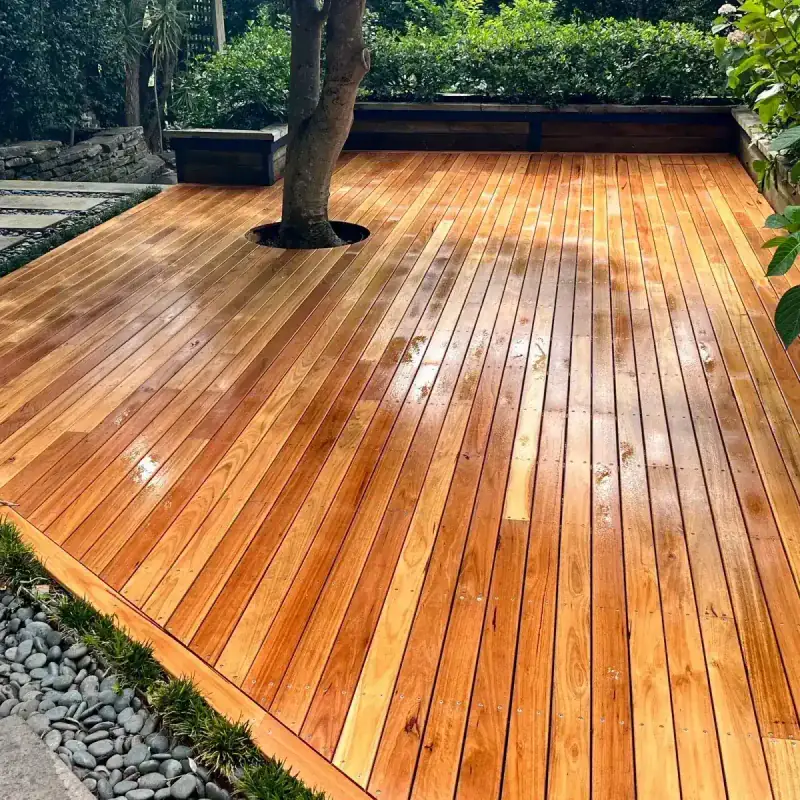
Spotted gum offers beautiful colour variation and excellent durability. It’s a bit lighter in colour and has become increasingly popular on the North Shore.
Both options:
- Require oiling every 1-2 years to maintain colour
- Will grey naturally if left untreated (which some homeowners prefer)
- Extremely durable and long-lasting
- Stand up well to Sydney’s coastal conditions
Premium Hardwood: $700 to $900 per m2
Premium options like ironbark and blackbutt offer exceptional durability and beautiful grain patterns.
Ironbark is one of the hardest timbers available, extremely durable, and naturally fire-resistant. It’s a popular choice around pools and in bushfire-prone areas.
Blackbutt offers a lighter, more contemporary look with excellent durability and minimal movement.
Composite Decking Costs
Composite decking is made from a combination of recycled wood fibres and plastic. It’s become increasingly popular for homeowners who want low maintenance.
Mid-Range Composite: $550 to $750 per m2
Mid-tier composite brands offer good durability and a range of colours without the premium price tag.
Benefits:
- No oiling, staining, or painting required
- Won’t splinter, crack, or rot
- Consistent colour throughout
- Good warranties (typically 15-25 years)
Considerations:
- Can get hot underfoot in full sun
- Doesn’t have the same natural feel as timber
- Some cheaper composites fade over time
Premium Composite: $750 to $950 per m2
Brands like Trex, Modwood, and Ekodeck represent the premium end of composite decking.
What you get:
- Superior fade resistance and colour retention
- More realistic timber grain patterns
- Better heat reflection (cooler underfoot)
- Longer warranties (25-50 years)
At LikeSilk Building, we find that clients who choose premium composite are typically focused on long-term value and minimal ongoing maintenance rather than lowest upfront cost.
Timber vs Composite: Which Is Right for You?
Choose timber if:
- You prefer the natural look and feel
- You’re comfortable with regular oiling/sealing
- Budget is tight (treated pine is most affordable)
Choose composite if:
- You want zero maintenance beyond occasional cleaning
- You’re concerned about splinters (families with young children)
- You prefer predictable long-term costs
What Affects Your Deck Cost?
Size and Shape
Larger decks generally cost less per square metre because setup and mobilisation costs are spread across more area. A simple rectangular deck is also cheaper than complex shapes with angles, curves, or multiple levels.
Budget impact: Complex designs can add 20-30% to your total cost.
Site Access and Conditions
If your backyard is only accessible through the house or down a steep slope, material delivery and waste removal become more expensive and time-consuming.
Budget impact: Difficult access can add $2,000 to $5,000+ depending on severity.
Height and Structural Requirements
Ground-level decks are simpler and cheaper than elevated decks. Once you’re building above 1 metre, you’ll need more substantial structural support, posts, and bearer systems. You’ll also need balustrades for safety.
Budget impact: Elevated decks cost 30-50% more than ground-level equivalents.
Balustrades and Stairs
Any deck over 1 metre high requires compliant balustrades.
Typical costs:
- Timber balustrades: $200 to $350 per linear metre
- Stainless steel and glass: $500 to $800+ per linear metre
- Stairs: $800 to $2,500 depending on height and design
Council Approvals
Decks over a certain size or height may require development approval or a complying development certificate from your local council. This adds time and cost to your project.
Budget impact: $1,500 to $3,000 for documentation and approval fees.
What’s Included in a Deck Quote?
What Should Be Included
A comprehensive deck quote should cover:
- All materials (decking boards, subframe timber, fixings, fasteners)
- Labour for full installation
- Site preparation (minor levelling, clearing)
- Subframe construction (bearers, joists, posts, footings)
- Decking board installation
- Any necessary balustrades and stairs
- Waste removal
- Basic cleanup
What’s Often Excluded
Watch for these common exclusions:
- Extensive excavation or earthworks
- Removal of existing structures (old decks, pavers, sheds)
- Council approval costs and engineering
- Electrical work (outdoor lighting, power points)
- Landscaping restoration
Questions to Ask Your Builder
Before accepting a quote:
- What timber grade is included? (There’s a big quality difference within the same species)
- Is the subframe treated pine or hardwood?
- What fastening system will you use? (Hidden fasteners look cleaner but cost more)
- Does the quote include all balustrades and stairs?
- What’s your approach to drainage and ventilation?
- What warranty do you offer on workmanship?
Real-World Deck Cost Examples
Small Deck (15-20m2)
New build: Simple rectangular ground-level deck, merbau timber, no balustrades
Cost range: $8,000 to $15,000
This suits a small entertaining area off a kitchen or as a side entry upgrade.
Medium Deck (25-35m2)
New build: Elevated deck off living area, spotted gum decking, timber balustrades and stairs
Cost range: $18,000 to $30,000
This is the most common size we build at LikeSilk Building. It creates a genuine outdoor living space that extends your home for entertaining and family life.
Large Deck (40-60m2)
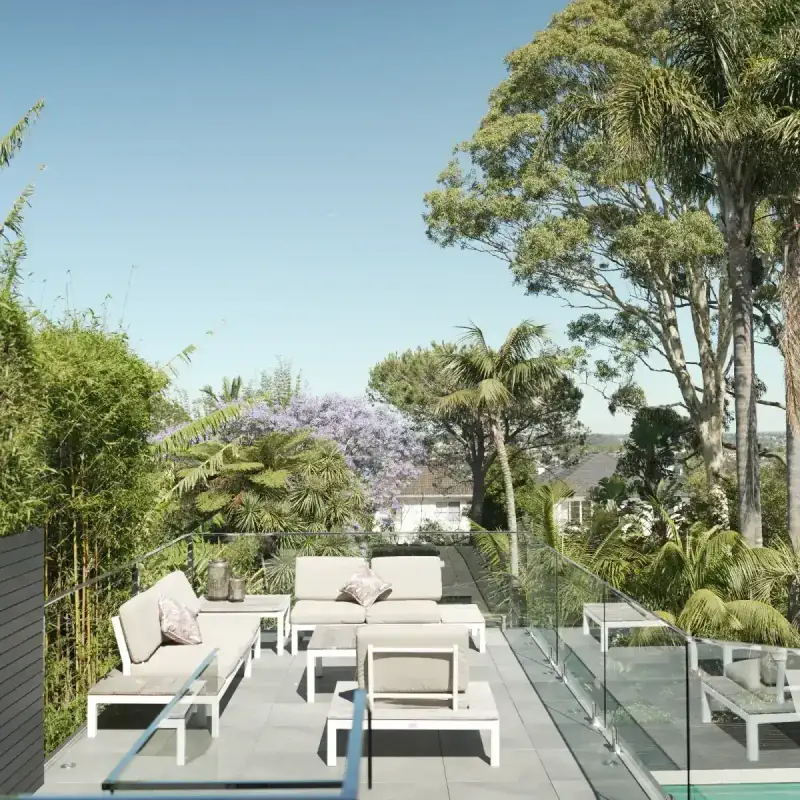
New build: Multi-level deck with premium composite, glass balustrades, integrated seating
Cost range: $35,000 to $55,000
Re-decking Example
Project: 55m2 pool deck, spotted gum boards on existing frame, includes demo, oiling, and reinstalling glass balustrade
Cost range: $22,000 to $28,000
People Also Ask
How much does a deck cost in Australia?
Across Australia you can expect to pay $350 to $950 per square metre for a professionally built new deck. Sydney sits at the higher end of this range due to labour costs and stricter building standards.
What’s the average cost for a 20x20 deck?
A 20x20 deck in feet translates to approximately 37 square metres. Based on current Sydney pricing for a new build, this would cost between $13,000 (basic treated pine) and $35,000 (premium composite) for materials and labour.
Is it cheaper to build or buy a deck?
If you’re comparing a DIY build to hiring a professional, DIY will save you labour costs but you’ll still pay full retail for materials. A DIY deck might cost 30-40% less than a professional build, but you take on all the risk of structural errors, code compliance issues, and warranty concerns.
What is the 30cm rule for decking?
The 30cm rule refers to the required clearance between the bottom of the deck structure and the ground. This gap allows for airflow, reduces moisture build-up, prevents termite access, and ensures the timber subframe stays dry.
How to Get an Accurate Quote
Information to Have Ready
When you contact builders, be ready to share:
- Approximate size you’re considering
- Preferred material (or be open to recommendations)
- Whether the deck is ground-level or elevated
- Photos of the site and access points
- Any design features you want (built-in seating, planter boxes, etc.)
Red Flags When Comparing Quotes
- Significantly cheaper than others (what’s been left out?)
- Vague descriptions like “all materials included”
- No breakdown of what’s covered
- Pressure to sign immediately
- No licence number or insurance details (you can verify licences on NSW Fair Trading)
Key Takeaways
Building a deck in Sydney is a significant investment, but it adds valuable outdoor living space and can increase your home’s appeal.
Remember:
- Budget $350 to $950 per m2 for new builds, $250 to $600 for re-decking
- Timber requires maintenance but offers natural beauty
- Composite costs more upfront but needs virtually no maintenance
- Site conditions and design complexity significantly affect cost
- Always get quotes that clearly detail what’s included
If you’re planning a deck as part of a larger renovation or as a standalone project, we can help you understand what’s realistic for your site and budget. At LikeSilk Building, we work with homeowners across Sydney’s North Shore to create outdoor spaces that enhance how they live and entertain at home.
Ready to explore what’s possible for your deck project? Get in touch for a no-obligation site visit and realistic quote. We’ll discuss your goals, explain your options, and give you a clear picture of what to expect.