Water marks on the ceiling below your balcony. Rust staining around the drainage point. Grout that keeps cracking back no matter how many times you repoint it. These are the kinds of things homeowners on the North Shore and Northern Beaches notice quietly for months before they call anyone.
When they do call, they usually hear from a waterproofing company offering a membrane quote. Sometimes that is the right answer. But on an older Sydney home, particularly one built before the 1990s with a timber-framed balcony, the membrane is rarely the whole story. What failed is usually the design underneath it, and fixing it properly means understanding what actually went wrong.
This is a builder’s explanation of what is happening in those situations, what a proper fix involves, and what it costs when you do it right.
The short version
Older Sydney balconies commonly fail because the tiled surface was installed flush with the internal floor level, with no step-down to redirect water and no proper drainage through the framing. By the time visible signs appear, the membrane has often been failing for years and the substrate is already compromised.
Proper waterproofing is a multi-trade sequence: demolition, structural check, drainage, AS 4654.2 compliant membrane (1:100 minimum fall, 100mm upstands, 50mm step-down), then surface finish.
A full single-balcony refurbishment in Sydney runs $18,000 to $55,000. A three-balcony project in Balgowlah Heights on Sydney’s Northern Beaches cost $220,000 to $240,000 over 10 weeks.
The membrane cost per square metre is a fraction of the total. The real cost drivers are demolition, structural remediation, drainage, and the surface finish.
Why older Sydney balconies fail (and it is not just the membrane)
Most homeowners think balcony waterproofing is a membrane job. Swap out the old membrane, put new tiles down, done. On a new-build concrete slab balcony with correct drainage, that is sometimes true. On a pre-1990s timber-framed Sydney house, it almost never is.
The membrane fails because of three design decisions that were standard practice in older builds and are now understood to be wrong.
The first is flush floor levels. The tiled balcony floor was installed at the same finished level as the internal floor just inside the door. There is no step-down. Water has no direction to drain away from the building, so it pools at the threshold and finds the weakest point: a grout joint, a balustrade post fixing, the junction between the wall and the floor membrane. Once it gets behind the membrane, it sits there.
The second is insufficient falls in the bedding. AS 4654.2 requires a minimum fall of 1:100 to direct water toward drainage points. Many older balconies have no measurable fall, or the fall is in the wrong direction, pulling water toward the wall instead of the drain. A membrane applied over flat bedding is fighting a losing battle from the day it goes on.
The third, on many older homes, is no drainage at all. On the three-balcony refurbishment we completed in Balgowlah Heights, this is exactly what we found. The original balconies had no stormwater drainage through the floor framing. Water had no path out. The original tiles sat flush with the internal floor level, the bedding falls were inadequate, and there was no drainage connection. The membrane had been quietly failing for years.
By the time visible signs appear above or below a balcony, the damage is usually well advanced. The substrate is wet, the plasterboard ceiling below has absorbed moisture, and the balustrade post fixings may already be corroding. The surface symptoms are real information, but they understate what is happening underneath.
If the balcony floor tiles sit at the same level as the internal finished floor, that is not a cosmetic issue. It is a design fault that almost always results in a failed membrane over time.
The warning signs your balcony needs professional attention
These are the observable signs that something is wrong at the substrate level. Most homeowners have already noticed one or two of them before they start searching for a waterproofer.
- Water marks, bubbling paint, or sagging plasterboard on the ceiling directly below the balcony. This is the clearest sign water has been tracking through the structure. By the time the ceiling is showing, the damage above it is significant.
- Efflorescence on the balcony surface or the fascia below. The white chalky deposits appear when water moves through a substrate and carries dissolved salts to the surface. It indicates water has been moving through the structure, not draining away from it.
- Rust staining around drainage points or at the base of balustrade posts. Water is sitting around metal fixings. On older balconies with post-fixed balustrades, this can compromise the structural integrity of the fixing itself.
- Grout that keeps cracking back. Particularly if the cracking occurs in the same location repeatedly, or if tiles in that area sound hollow when you tap them. Hollow tiles indicate the bedding underneath has separated from the substrate, usually due to moisture.
- The balcony tile surface sits level with the internal floor. Check with a straight edge across the door threshold. If there is no noticeable step-down from inside to outside, the drainage design is wrong. This alone is a strong indicator of future or current membrane failure.
- Loose or moving balustrade posts. Corrosion at the base fixing reduces the structural capacity of the balustrade. This is a safety issue as well as a waterproofing one.
- A persistent smell of dampness in rooms adjacent or below the balcony. Moisture has found its way into the structure and is not drying out.
If the balcony floor tiles are level with or higher than the internal finished floor level, water is finding its way inside every time it rains. The question is how much damage has already been done.
If you are seeing more than two of these signs, the most useful next step is an on-site inspection. We can assess what is happening at the substrate level and give you an honest picture of what you are dealing with before any work starts.
What a proper balcony waterproofing refurbishment involves
This is where most waterproofing trade pages stop at “apply the membrane.” The reason a proper refurbishment takes weeks rather than days, and costs significantly more than a membrane quote, is that the membrane is step three in a five-step sequence. Each step depends on the previous one being done correctly.
Stage 1: Demolition and assessment
Everything comes off: existing tiles, tile bedding, old membrane if one exists, and any plasterboard ceilings beneath the balcony. This is not optional. You cannot assess the condition of the substrate through the existing surface, and you cannot fix the drainage and falls without removing what is there.
At Balgowlah Heights, demolition covered approximately 65m2 of external tiling, 35m2 of decking across three balconies, 45 linear metres of combined glass and stainless steel wire balustrading, and 95m2 of plasterboard ceilings beneath. That gives you a sense of the real scope of a three-balcony refurbishment.
On older timber-framed houses, demolition is also the point where a structural engineer gets involved. Once the frame is exposed, it needs to be assessed for rot, non-compliant framing, or corrosion at fixing points before any waterproofing work begins. At Balgowlah Heights, remedial carpentry was required across all three balconies after the engineer’s inspection. That is a normal outcome on older Sydney homes. Attempting to waterproof over a compromised timber frame is a short-term fix, not a solution.
Stage 2: Drainage and falls
Before any membrane goes on, drainage has to be correctly set. Drainage points are installed through the floor framing and connected to the stormwater system. The substrate is then set with the correct bedding fall, a minimum of 1:100 under AS 4654.2, so water moves toward the drains and does not pool.
At Balgowlah Heights, this was the first time any of the three balconies had stormwater drainage through the floor framing. The original balconies had none. This is a common finding on older homes. It is also one of the most important parts of the job, because a membrane installed over a substrate with no drainage or wrong falls will fail again, regardless of how good the membrane is.
Stage 3: Waterproofing membrane
The membrane used at Balgowlah Heights was Optiseal OC2100, a self-adhesive butyl sheet membrane reinforced with nonwoven polyester. Sheet membranes are commonly specified on timber-framed structures because they have good movement tolerance as the timber expands and contracts. Liquid membranes (Bostik, Tremco, and similar products) are also compliant under AS 4654 and widely used, particularly on concrete substrates.
Key compliance requirements under AS 4654.2:
- Membrane must turn up at least 100mm at all wall junctions and adjoining surfaces
- A minimum step-down of 50mm from the internal finished floor level to the finished balcony surface must be achieved in the construction
- All drainage points and balustrade post penetrations must be fully flashed and integrated into the membrane
A protection layer is installed on top of the membrane before the surface finish goes on, to prevent damage from subsequent trades working over it.
Cure time is part of this stage and it cannot be compressed. A membrane that is overloaded before it has fully cured will fail. This is why a waterproofer quoting a two-day turnaround for a full waterproofing job is not building cure time into their schedule.
Stage 4: Surface finish
Two main approaches are used on residential balcony refurbishments.
A pedestal paver system elevates pavers on adjustable plastic pedestals above the membrane surface, leaving a drainage gap underneath. Water drains through the paver joints, across the membrane below, and out to the drainage points. Because the pedestals are adjustable, the finished floor can be set perfectly level even when the substrate has drainage falls built in. The pavers can also be lifted for future membrane inspection or repair without demolishing the surface finish.
The Maximus Junior adjustable pedestal system was used across all three balconies at Balgowlah Heights. It is increasingly the preferred approach on residential refurbishments for serviceability reasons. If the membrane ever needs to be accessed, the surface can come up without a full demolition.
Traditionally bedded tiles can also be used and are fully compliant under AS 4654.2 when correctly installed. The bedding must be set to maintain the correct drainage falls, and if the membrane ever needs repair, tiles and bedding both have to come up. For older homes where future maintenance access is a consideration, pedestal systems are generally the better long-term choice.
Stage 5: Balustrade, ceiling, and reinstatement
Balustrade installation, ceiling reinstatement below the balconies, any electrical work, and final waterproofing checks. This phase is often where the timeline extends on multi-balcony projects because trades have to sequence correctly and inspections happen at specific points.
At Balgowlah Heights, this stage included 45 linear metres of frameless Starphire toughened glass balustrade with a chrome handrail, 95m2 of new Aquachek moisture-resistant plasterboard ceilings beneath the three balconies, new external downlights with motion and daylight sensors, three VELUX FCM fixed skylights above the top balcony, and a new Colorbond roof over the first-floor balcony.
Balcony refurbishment costs in Sydney: what to expect
The number most homeowners find when they search for balcony waterproofing costs is a membrane rate per square metre. That figure is real, but it does not reflect the cost of a full refurbishment. The membrane is one line item in a multi-trade job.
| Scope | Typical cost range (Sydney, 2026) |
|---|---|
| Small single balcony, waterproofing only (concrete slab, sound substrate, no structural issues) | $9,000 to $17,000 |
| Medium single balcony, full refurbishment (timber frame, new membrane, pedestal pavers, drainage) | $20,000 to $38,000 |
| Large single balcony, full refurbishment with new balustrade | $34,000 to $60,000 |
| Multi-balcony refurbishment (3 balconies, North Shore or Northern Beaches house) | $150,000 to $260,000+ |
| Waterproofing membrane alone (subcontractor only, no surface finish) | $60 to $100 per m2 |
These ranges reflect the full scope: demolition, structural inspection, remedial framing where required, drainage installation, AS 4654.2 compliant membrane with protection layer, and surface finish. They do not include balustrade replacement, ceiling reinstatement, electrical, or additional scope items like skylights or roof work. Those add to the total, but they also address the real condition of the building, not just the membrane.
A balcony waterproofing quote that covers only the membrane is not a full project quote. The biggest cost drivers are demolition, structural remediation, drainage, and the surface finish, not the membrane itself.
Our most recent balcony project, a three-balcony refurbishment at Balgowlah Heights on Sydney’s Northern Beaches, came in at $220,000 to $240,000 on a cost-plus arrangement. That covered three full balconies, 45 linear metres of Starphire glass balustrading, 95m2 of new Aquachek ceilings, three VELUX FCM skylights, a new Colorbond roof, all drainage and stormwater connections, structural engineering and remedial framing, and all electrical. Older balconies hide more than they show. Budget accordingly.
See what a full three-balcony refurbishment looks like from demolition to handover. The Balgowlah Heights project page has the full project story, before and after images, scope list, and FAQs. Read the Balgowlah Heights project story
How long does a balcony refurbishment take in Sydney?
A single-balcony refurbishment with no major structural complications typically runs 4 to 6 weeks. A multi-balcony project runs longer because the same sequence has to complete on each balcony before the next starts, and trades have to be sequenced so nothing overloads a curing membrane.
| Phase | Typical duration |
|---|---|
| Scaffold setup | 1 to 2 days |
| Demolition | 2 to 5 days (depending on size and number of balconies) |
| Structural engineer inspection and report | 1 to 3 days |
| Remedial carpentry if required | 1 to 5 days depending on extent |
| Drainage installation | 1 to 3 days |
| Waterproofing membrane application and cure | 3 to 7 days (membrane must cure fully before loading) |
| Surface finish: pedestal pavers or bedded tiles | 2 to 5 days per balcony |
| Balustrade installation | 3 to 5 days for a typical house |
| Ceiling reinstatement below balconies | 3 to 5 days |
| Electrical fit-off, clean, and handover | 1 to 3 days |
The Balgowlah Heights three-balcony project ran for 10 weeks. That covered scaffold setup, demolition of all three balcony floors and the ceilings beneath, structural engineering, remedial framing, waterproofing and drainage, a new Colorbond roof and three VELUX skylights above the top balcony, 45 linear metres of glass balustrading, new ceilings, electrical rough-in and fit-off, and final handover.
Cure time applies to every project regardless of size. It is not something that can be compressed because the project schedule is running tight.
Products used on older Sydney balconies (and why they were specified)
The Balgowlah Heights project used specific products for specific reasons. Understanding why helps when you are comparing quotes and evaluating what different products actually mean for the long-term performance of your balcony.
Optiseal OC2100. Self-adhesive butyl sheet membrane reinforced with nonwoven polyester. Applied across all three deck surfaces, wall junctions, drainage points, and penetrations. Specified for timber-framed structures because of its movement tolerance. Timber moves seasonally, and a membrane with good movement capacity accommodates that without cracking.
Maximus Junior adjustable pedestal paver system. Adjustable plastic pedestals support the pavers above the membrane, leaving a drainage gap underneath. Water drains through the paver joints, across the membrane, and to the drainage points. The adjustable feet mean the finished floor sits perfectly level on all three balconies even though the substrate has drainage falls built in. If the membrane ever needs to be accessed, the pavers lift. No demolition required.
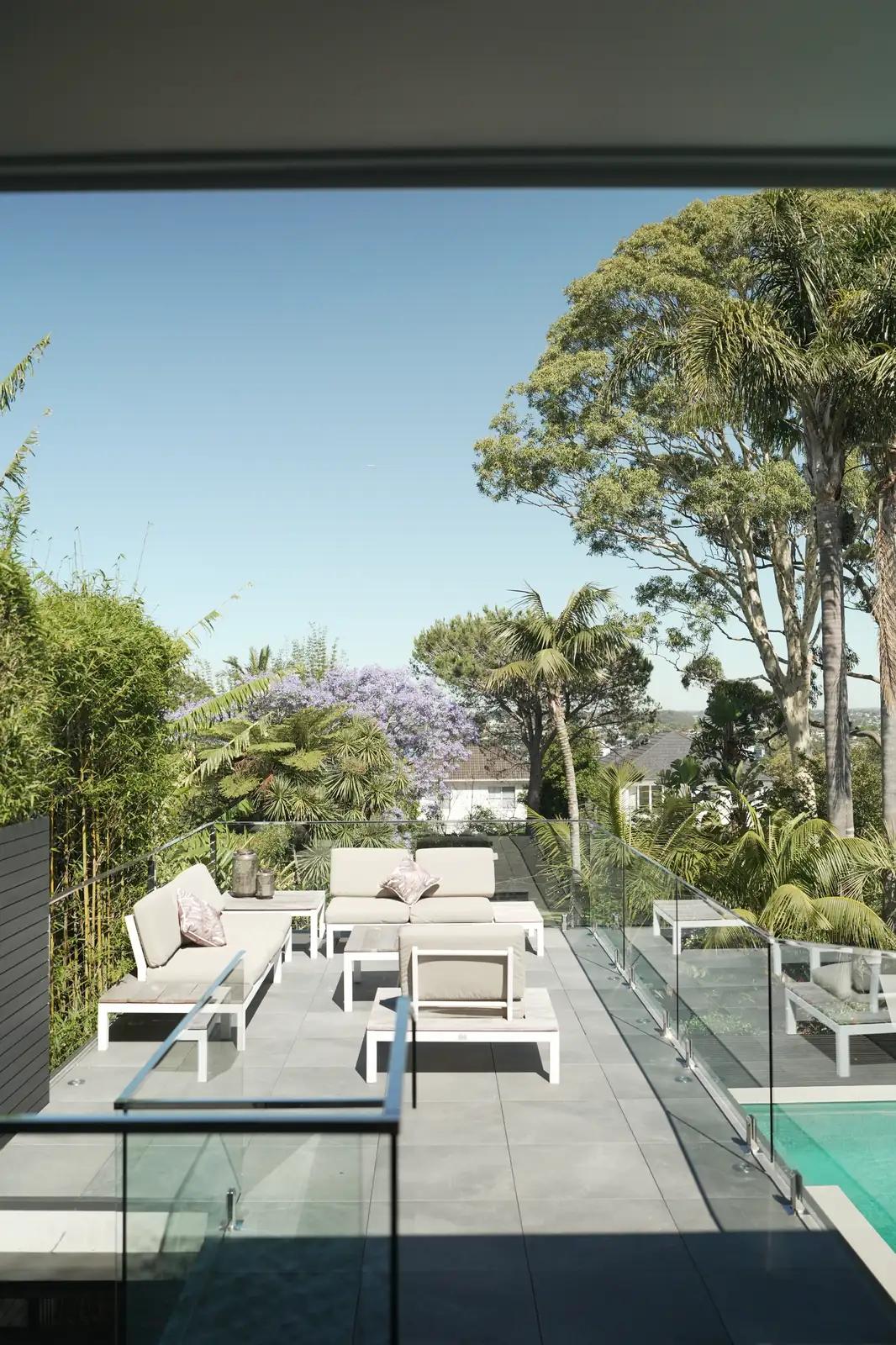
Starphire toughened glass balustrades. Starphire is a low-iron glass. Standard toughened glass has a visible green tint, particularly at the edges and in larger panels. Starphire does not. On a balcony with a garden view or a water view, the difference is visible and significant. The Balgowlah Heights balconies look out over palms, a pool, and surrounding gardens. Standard glass would have tinted everything slightly. Approximately 45 linear metres of frameless Starphire panels were installed with a chrome handrail. It costs more than standard toughened glass, but on a premium residential balcony where the view is the point, it is the right product.
Aquachek moisture-resistant plasterboard. Used for the 95m2 of ceiling reinstatement beneath the three balconies. Standard plasterboard is not appropriate in areas with moisture exposure. Where a balcony has leaked, the ceiling below has almost always absorbed moisture. Aquachek is specified for these applications because it resists swelling and deterioration in damp conditions.
Do you need council approval for balcony waterproofing in Sydney?
For most homeowners, the answer is no, but there are exceptions worth understanding.
Waterproofing repair and replacement on an existing balcony is generally classified as maintenance work in NSW and does not require a DA or CDC. The same applies to replacing the surface finish like tiles or pedestal pavers, provided the structure of the balcony itself is not being altered.
If the scope extends to structural modifications, such as changing the balcony’s footprint, adding a new structural element, or altering load-bearing components, a CDC or DA may be required depending on the local council and the specific work.
Properties in heritage conservation areas or individually listed heritage items may have additional requirements even for maintenance work. If your home is heritage listed, check with your local council before committing to a scope.
For strata properties, the owners corporation typically has its own approval process for balcony refurbishment work, separate from council requirements. Strata by-laws govern what lot owners can change in common property areas, which often includes balcony structures. Check the by-laws and get strata approval in writing before any work starts. This applies regardless of whether council approval is also required.
The structural engineering review that follows demolition on an older timber-framed balcony is a quality control step carried out by the engineer you engage, not a council submission. It confirms the framing is sound and signs off the waterproofing and drainage approach. It is not a DA requirement.
For a broader guide on when council approval applies to building work in NSW, see our guide to DAs and CDCs in NSW.
If you want to verify the licence of any builder you are considering, NSW Fair Trading has a free licence check tool that takes about thirty seconds. Enter the licence number and confirm it is current and in their name.
A note on decks versus balconies
These are different structures and the waterproofing requirements are different.
A timber deck at ground level or just above it is a ventilated structure. Air moves beneath it. Water drains through the gaps between boards. The framing dries out. There is typically no membrane involved and no room below that water can damage.
A balcony is a sealed, elevated structure with a habitable or accessible space beneath it. It requires a compliant waterproofing membrane, correctly installed drainage, and correct floor level step-downs because failure means water getting into the structure below. The consequences of a failing balcony membrane are structural, not cosmetic.
If you are researching a new timber deck as a separate project, our deck cost guide for Sydney covers what a deck build actually costs in 2026. The two posts are intentionally separate because the structural requirements, the products, and the cost drivers are different enough that combining them would mislead readers on both.
What a LikeSilk balcony assessment looks like
We inspect on-site before offering any scope or budget guidance. A desktop estimate for a balcony refurbishment on an older Sydney home is not useful because you cannot know the condition of the substrate, the drainage, or the framing without seeing the building. A number given without a site visit is not a commitment, regardless of what the quote document says.
After an on-site inspection, we can tell you whether the situation warrants a full refurbishment or whether a targeted repair is genuinely appropriate. If a reseal is the right call, we will say so. We will not recommend a full rebuild if it is not needed.
If the project does proceed, a structural engineer is engaged after demolition on older timber-framed balconies to confirm the framing and sign off on the waterproofing and drainage approach. That step is not optional and it is not negotiable on a job where we are putting our name on the finished result and our licence on the paperwork.
I have seen the flush-floor-level pattern on multiple North Shore and Northern Beaches homes: no step-down, no drainage through the framing, membranes that were never AS 4654 compliant. Knowing what to look for changes the scope and budget picture significantly. It also means that what looks like a simple membrane patch on the surface is sometimes a full refurbishment once the building is properly assessed.
Cameron Gerardis, LikeSilk Building, NSW Builder Licence 274849C. Family-run, North Shore Sydney.
For more on how we work with clients through a project like this, from initial assessment through to handover, see how we work.
When you are ready to compare quotes from builders, our renovation quote comparison guide covers what to ask and what to look out for, including how to normalise quotes that scope the job differently.
We work across Sydney’s North Shore and Northern Beaches. If your balcony is showing any of the signs above, we are happy to come and take a look. A site inspection is the only way to give you an honest picture of what is actually happening. No obligation, just a straight assessment from a licensed builder.
Frequently asked questions
How much does balcony waterproofing cost in Sydney?
The cost depends heavily on the scope. Waterproofing membrane applied by a subcontractor to an existing, sound substrate typically runs $60 to $100 per square metre. A full balcony refurbishment including demolition, structural inspection, drainage installation, a compliant AS 4654.2 membrane, surface finish, and balustrade work runs $20,000 to $60,000 for a single residential balcony in Sydney. A three-balcony project in Balgowlah Heights cost $220,000 to $240,000 on a cost-plus arrangement over 10 weeks. The membrane cost is a fraction of the total. The biggest drivers are demolition, structural remediation, drainage, and the surface finish.
What are the signs my balcony needs waterproofing?
The most common signs on older Sydney homes are: water marks or sagging plasterboard on the ceiling below the balcony, efflorescence on the surface or fascia, rust staining around drainage points or balustrade post bases, grout that keeps cracking back, tiles that sound hollow or have lifted, and any situation where the balcony tile surface sits level with the internal finished floor. Two or more of these together suggests the membrane has already failed.
What is a pedestal paver system on a balcony?
A pedestal paver system uses adjustable pedestals to support pavers above the waterproofed deck surface, leaving a drainage gap underneath. Water drains through the joints, across the membrane, and to the drainage points. The adjustable feet mean the finished floor can sit perfectly level even when the substrate has drainage falls built in. Pavers can be lifted for future membrane access without demolishing the surface. The Maximus Junior system was used at Balgowlah Heights.
What waterproofing standard applies to balconies in NSW?
External balconies and decks in NSW must comply with AS 4654.2, which requires a minimum fall of 1:100, membrane upstands of at least 100mm at all wall junctions, and a minimum step-down of 50mm from the internal floor level to the finished balcony surface. This is distinct from AS 3740, which applies to internal wet areas. Work must be carried out by or under the supervision of a licensed builder in NSW.
How long does a balcony refurbishment take in Sydney?
A single-balcony refurbishment with no major structural complications typically takes 4 to 6 weeks. A three-balcony project in Balgowlah Heights took 10 weeks from scaffold setup to handover, including demolition, structural engineering, remedial framing, waterproofing, drainage, a new roof, skylights, glass balustrading, ceilings, and electrical. Membrane cure time is not negotiable and cannot be compressed.
Can I just reseal my balcony instead of a full refurbishment?
Resealing is only appropriate when the substrate is structurally sound, the existing bedding has correct drainage falls, and the membrane failure is genuinely superficial. On older timber-framed Sydney homes where the balcony sits flush with the internal floor level, resealing is almost never the right answer. The drainage is wrong, the substrate is usually already wet, and a reseal over a failed system is a short-term cosmetic fix while the structural damage continues underneath.
Do I need council approval for balcony waterproofing in Sydney?
Waterproofing and repair work on existing balconies is generally exempt development in NSW and does not require a DA or CDC. Structural modifications, heritage properties, and strata properties may involve additional requirements. For strata, get owners corporation approval in writing before any work starts. See our guide to DAs and CDCs in NSW for more.
What is the difference between Starphire glass and standard toughened glass?
Starphire is a low-iron glass with no green tint. Standard toughened glass has a visible green cast at the edges and in larger panels. On a frameless balustrade with a garden or water view, the difference is clearly visible. Starphire costs more but is the preferred product on premium residential balconies where the view is the point. Around 45 linear metres of frameless Starphire balustrading was installed at the Balgowlah Heights project.