Frequently Asked Questions
Everything you need to know about renovating with LikeSilk. From process and pricing to timelines and design, we have answered the questions homeowners ask most.
Showing 213 questions
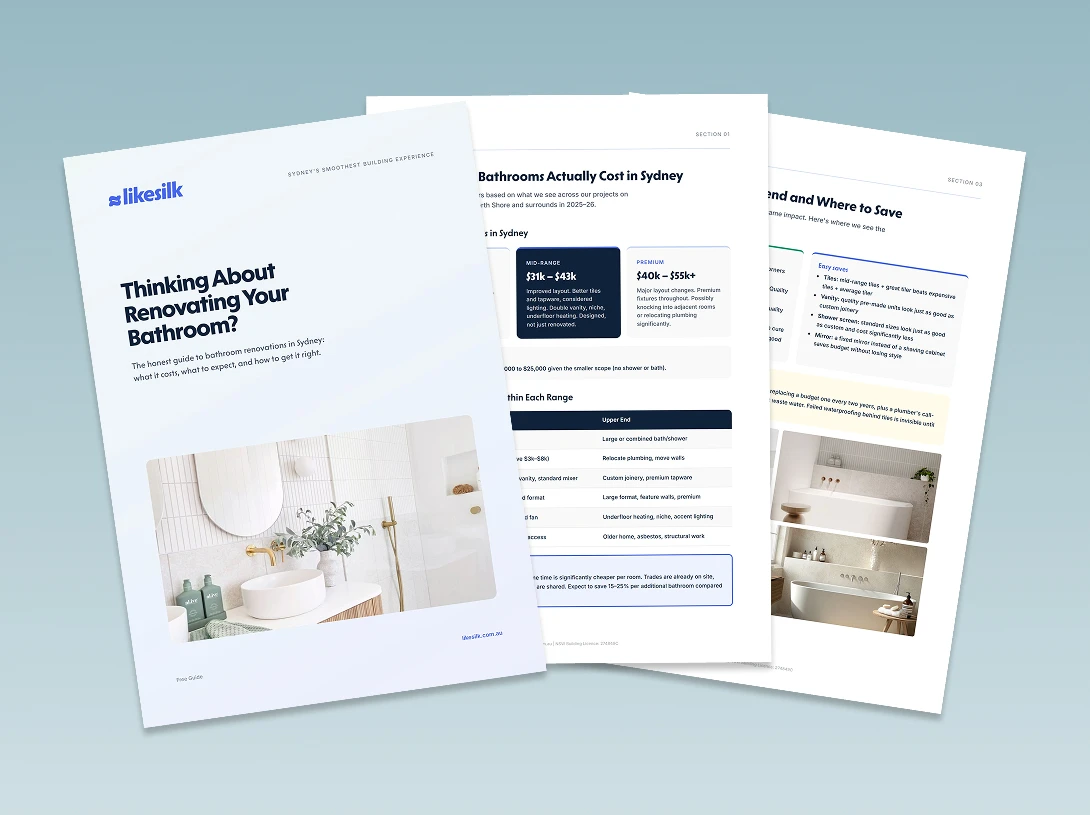
How much does a bathroom renovation cost in Sydney?
In Sydney, most bathroom renovations fall between $30,000 and $55,000. Waterproofing, tiling, and plumbing typically make up the largest share. Layout changes (moving the toilet or shower) add cost because they require new drainage and waterproofing to the full wet area. For a detailed breakdown by item, read our bathroom renovation cost guide for Sydney, or try the renovation calculator for a quick estimate.
How much does a first-floor addition cost in Sydney?
First-floor additions in Sydney typically range from $350,000 to $650,000, depending on size, complexity, and finishes. Structural engineering, scaffolding, and temporary weatherproofing add costs you won't see in a ground-floor renovation. We provide detailed, line-item quotes so you can see exactly where the money goes. Read our home extensions guide for more on what to expect.
What types of renovations does LikeSilk do in Sydney?
LikeSilk Building specialises in bathroom renovations, kitchen renovations, and interior renovations across Sydney's North Shore and surrounding suburbs. As a licensed renovation company in Sydney (licence 274849C), we handle everything from single-room updates to whole-home transformations. We manage every project end-to-end, so you deal with one team from first conversation to final walkthrough.
How much does an interior renovation cost in Sydney?
Most full interior renovations in Sydney start from around $130,000 for a complete internal refurbishment. Larger projects involving multiple rooms, structural changes, or high-end finishes can run from $200,000 to $500,000+. The biggest cost drivers are scope (how many rooms), whether you are changing the layout, and the quality of finishes. We provide line-item quotes so you can see exactly what each element costs. Read our guide to which renovations add the most value to help prioritise your spend.
How much does a kitchen renovation cost in Sydney?
Kitchen renovation costs in Sydney typically range from $35,000 to $75,000, depending on size, materials, layout changes, and appliance choices. Cabinetry and benchtops usually make up 40 to 50% of the total. LikeSilk provides line-item quotes so you can see exactly where every dollar goes. For a full breakdown, read our kitchen renovation cost guide for Sydney.
How much does a knockdown rebuild cost in Sydney?
Knockdown rebuild costs in Sydney typically range from $650,000 to $1,300,000+, depending on the design, block size, soil conditions, slope, and finish level. Demolition and site clearance alone can cost $30,000 to $60,000 depending on asbestos and access. We provide detailed, line-item quotes that separate demolition, site prep, construction, and finishes so you can see exactly where the money goes. Book a free planning call to discuss your project.
Are there hidden costs in a home renovation?
Not with LikeSilk. We offer both fixed-price and cost-plus contracts, and both are fully transparent. Before construction begins, we conduct a thorough pre-construction inspection to identify potential issues upfront rather than discovering them mid-build. Your contract clearly itemises all costs, allowances, and inclusions. If anything changes during the project, we discuss it with you and get written approval before any additional work proceeds. Read our building contract checklist to know what to look for.
How long does a home renovation take?
Timelines depend on the scope. A single bathroom or kitchen renovation typically takes 3 to 8 weeks on site. A larger whole-home renovation can take 3 to 6 months or more, depending on whether you need design, approvals, or both. We give you a clear timeline at the quoting stage and keep you updated throughout the build with daily progress reports. See our week-by-week timeline example to understand how a typical project runs.
Can I renovate my bathroom for under $10,000?
A $10,000 budget can cover cosmetic updates like new tapware, a vanity swap, paint, or replacing fittings. But a full renovation with waterproofing, tiling, and new plumbing will typically exceed this. Waterproofing alone (which is mandatory under NCC standards) costs $1,500 to $3,000 depending on the wet area size. We help you prioritise what to tackle now and what to stage for later.
Do I need council approval for a home extension in NSW?
Yes. Most home extensions in Sydney require approval via either a DA (Development Application) or CDC (Complying Development Certificate). A CDC is faster (1 to 4 weeks via a private certifier) but has stricter rules on setbacks and floor space ratios. A DA goes through council and can take 3 to 6 months. We determine which pathway suits your property at the site visit and manage the entire process.
What makes your approach unique?
We manage the entire renovation journey in one place: design, selections, approvals, construction, and handover. Most builders only handle the build, leaving you to coordinate everything else yourself. Our end-to-end process means one team, one point of contact, and no gaps between stages.
How much does a home renovation cost in Sydney?
Home renovation costs in Sydney depend on the scope. A single bathroom typically costs $30,000 to $55,000, a kitchen $35,000 to $75,000, and a full interior renovation starts from around $130,000 for a complete internal refurbishment. Larger projects involving multiple rooms, structural changes, or extensions can range from $240,000 to $650,000 or more. LikeSilk provides detailed, line-item quotes so you know exactly where your money goes. Use our renovation calculator for a quick estimate, or read our cost guides for kitchens and bathrooms.
How long does an interior renovation take?
Most interior renovations take 4 to 8 weeks on site, depending on how many rooms are involved and whether structural work is needed. A single-room update might take 3 weeks; a whole-home renovation can run 3 to 6 months including design and approvals. We lock in a schedule before work starts. See our renovation process.
What's included in a kitchen renovation cost breakdown?
A typical kitchen renovation includes demolition, cabinetry, benchtops, splashback, appliances, plumbing, electrical, flooring, and painting. Each line is itemised separately in our quotes so you can compare and adjust. Read our kitchen renovation cost guide for typical price ranges on each item.
What does it cost to build a new home?
New home construction in Sydney typically costs $3,500 to $5,500 per square metre, depending on design complexity, finishes, and site conditions. A 250sqm home could range from $500,000 to $1,000,000 in construction costs alone, before demolition and site prep. We provide honest, itemised pricing so you can compare inclusions properly. Read our building contract checklist to know what should be covered in your quote.
Are there hidden fees?
No. All costs are transparent and clearly outlined upfront. Your contract itemises every inclusion and exclusion so you can see exactly what you are paying for. If anything changes during the project, we discuss it with you and get written approval before any additional work proceeds. Read our building contract checklist for what to look for.
What is HBCF insurance and do I need it?
Home Building Compensation Fund (HBCF) insurance is mandatory in NSW for all residential building work over $20,000. It protects you if your builder is unable to complete the work or fix defects due to insolvency, death, or disappearance. LikeSilk arranges HBCF insurance for every qualifying project through icare NSW. You do not need to organise this yourself. Read our full explanation in what HBCF is and why it matters.
How long does a bathroom renovation take in Sydney?
A typical bathroom renovation takes 3 to 5 weeks on site. Tile selection and custom vanity lead times are the most common delays, so locking these in early saves time. We provide a week-by-week timeline before work starts so you know exactly what happens at each stage.
How long does a first-floor addition or extension take?
Most first-floor additions in Sydney take 6 to 9 months from design to completion. The approval stage (DA or CDC) can add 1 to 6 months depending on the pathway. Construction itself is typically 4 to 6 months. We provide a detailed schedule upfront. See our home extensions guide.
What is your mission?
Our goal is to make renovating feel simple, transparent, and organised. We arm our clients with knowledge at every step so they can make confident decisions without becoming renovation experts themselves. See our renovation process.
What areas of the home can you renovate internally?
We renovate all internal spaces: living rooms, bedrooms, kitchens, bathrooms, hallways, laundries, and studies. Whether you are updating one room or doing a full interior overhaul, we design and build everything as one coordinated project. See our end-to-end renovation process to understand how we manage multi-room projects.
Can I renovate my kitchen on a budget?
Yes. Smart choices like keeping the existing layout, choosing laminate benchtops over stone, and selecting standard cabinet sizes can cut costs significantly. Limiting plumbing and electrical changes also helps. We work with you to prioritise what matters most and find savings where they won't affect the finished result. See our small kitchen renovation ideas for practical budget-friendly approaches.
Can I keep my current landscaping, pool and gardens?
It depends on your site access and new home footprint. Existing pools, retaining walls, and established trees can sometimes be retained. Mature trees may be protected by council tree preservation orders. We assess this during the site visit. See our knockdown rebuild service.
Can you accommodate tight budgets?
Yes. We help you work out what is achievable within your budget and what to prioritise. Sometimes that means staging the work across two phases, or choosing mid-range materials in areas that won't affect the finished result. The important thing is getting an honest assessment upfront rather than starting a project you can't finish. Book a free planning call to talk through your budget.
What is the difference between fixed price and cost plus?
Fixed price means the total cost is agreed upfront before construction starts. You know exactly what you will pay, with no surprises. Cost plus means you pay the actual cost of materials and labour, plus an agreed margin. This gives full transparency on every dollar spent. Both models are available for all project types. We walk you through the pros and cons of each so you can choose what suits your situation. Read our detailed comparison of fixed-price vs cost-plus contracts.
What are the stages of a bathroom renovation?
A bathroom renovation follows this sequence: strip-out and demolition, plumbing and electrical rough-in, waterproofing (must pass inspection before tiling), tiling, cabinetry and vanity installation, fit-off (tapware, toilet, shower screen, accessories), and final clean. Each stage depends on the one before it, which is why scheduling matters. Read our bathroom renovation checklist for the full list of what to plan for.
Can I live in my home during the extension build?
For rear extensions, usually yes. For second-storey additions, it depends on the stage. During the structural and roofing phase, there may be periods where temporary relocation is safer and more practical. We stage the build to keep disruption to a minimum and discuss the logistics with you during your free planning call so you can plan ahead.
What makes LikeSilk different from other renovation companies in Sydney?
LikeSilk manages your entire renovation journey in one place: design, material selections, council approvals, construction, and handover. Most Sydney renovation companies only handle the build, leaving you to coordinate designers, suppliers, and approvals yourself. Our end-to-end process means one team, one point of contact, and full transparency from start to finish. As a family-run builder on the North Shore, we treat every project as if it were our own home.
What's included in a full interior home renovation?
A full interior renovation typically includes layout reconfiguration, updated lighting, flooring, painting, built-in joinery, electrical upgrades, and new kitchens and bathrooms. We also handle any structural work, waterproofing, plastering, and tiling. Everything is scoped and priced upfront in your building contract so there are no surprises.
How long does a kitchen renovation take from start to finish?
Most kitchen renovations take 6 to 10 weeks from demolition to handover. Simpler cosmetic updates can be done in 4 weeks. Material lead times (especially stone benchtops and custom joinery) are often the biggest variable. See our kitchen renovation cost guide.
What are the pros and cons of a knock down rebuild over a renovation?
A knockdown rebuild gives you a brand-new home designed exactly to your needs, with modern insulation, wiring, and plumbing throughout. It often costs less per square metre than a major renovation on an older structure, where hidden issues (asbestos, termite damage, non-compliant wiring) can blow out the budget. A renovation keeps the home's existing character and may be faster if the structure is sound. We help you weigh up both options at the site visit.
Do you provide cost estimates upfront?
Yes. We provide initial cost guidance after the site visit, then refine it as the design and scope are finalised. Once we agree on the scope, you receive a detailed line-item quote before any work begins. Read our fixed-price vs cost-plus guide to understand the two pricing models we offer.
Do I need council approval for my renovation?
It depends on the scope of work. Smaller renovations like a bathroom or kitchen refresh typically do not require approval. Larger projects may need either a Complying Development Certificate (CDC) or a Development Application (DA). A CDC is assessed by a private certifier and usually takes 1 to 4 weeks. A DA goes through your local council and can take 3 to 6 months or longer. We determine which pathway applies at your site visit and manage the entire approvals process on your behalf. Read our full guide to DA vs CDC approvals.
Do I need a licensed builder for a bathroom renovation in NSW?
Yes. In NSW, any residential renovation work valued over $5,000 must be carried out by a licensed builder. LikeSilk Building holds licence 274849C and provides HBCF home warranty insurance and waterproofing certification on every bathroom renovation. This protects your investment and ensures all work meets NSW building regulations and Australian Standards.
What's the difference between a DA and a CDC?
A DA (Development Application) is assessed by your local council and can take 3 to 6 months. It allows more flexibility but involves neighbour notification and potential objections. A CDC (Complying Development Certificate) is a fast-tracked approval via a private certifier, usually taking 1 to 4 weeks, but your project must meet strict criteria on setbacks, height, and floor space ratio. We explain the pros and cons in detail in our DA vs CDC guide.
Who are your founders?
LikeSilk was founded by Cameron and Kate. Cam has worked every role in construction, from carpenter to estimator to operations manager, and knows exactly where projects go wrong. Kate comes from SaaS product strategy and designs the client experience. Together, they built LikeSilk to deliver what other builders don't: a smooth, organised renovation process. Learn more on our about page.
What should I consider before renovating my home interior?
Think about how you actually use each room day to day. Where do you need more storage? Where does natural light fall? Is the layout working for how your family lives now, or how it lived 10 years ago? These practical questions matter more than finishes at the planning stage. We walk through all of this during your free planning call so you can prioritise before committing to a scope.
Can I live in my home during a kitchen renovation?
Yes, most of our clients stay at home during kitchen renovations. We set up a temporary kitchen area (usually the laundry or dining room) and use dust barriers to keep the rest of the house liveable. Daily site cleans and clear communication about which areas are off-limits make a big difference. We talk through the logistics during your free planning call.
Can you knockdown rebuild your home if you still have a mortgage?
Yes, but you will need lender approval. Most banks allow it if the property value and your equity support it. Your lender will want to see approved plans and a signed building contract before releasing funds. Check with your lender early in the process.
How do you determine the budget for my project?
We start with the site visit to understand the scope, then build estimates based on real trade costs and material pricing. As selections are made, the budget gets more precise. We work with you to match the scope to your budget. Read our fixed-price vs cost-plus guide to understand the pricing models.
What happens at a site visit?
We come to your property, walk through the space together, and talk about what you want to achieve. We discuss the scope, your budget, and any ideas you have. From this visit we understand what the project involves, whether you need approvals, and where you are in the process already. There is no cost and no obligation. Book your free site visit here.
Do I need council approval for a bathroom renovation?
Most bathroom renovations in Sydney do not need council approval if you are not changing structural walls, the building footprint, or external plumbing runs. If structural work is involved, you may need a DA or CDC approval. Heritage-listed properties can have additional requirements even for internal work. We confirm what applies to your property during the planning stage.
Will a home extension increase my property value?
In most cases, yes. Adding liveable floor area (especially bedrooms and living space) is one of the strongest value-adds in the Sydney market. A well-designed second storey or rear extension can add significantly more value than it costs, particularly in established North Shore suburbs where land prices are high and buyers expect generous floor plans. For more on ROI, read our guide to which renovations add the most value.
Where are you based?
We are based on Sydney's North Shore. We service the Lower North Shore, Upper North Shore, Northern Beaches, Inner West, and surrounding suburbs. See our areas we build page for specific suburbs.
How do I get started with an interior renovation project?
Book a free renovation planning call. We will come to your home, walk through the space with you, and talk about what you want to achieve. From there, we map out the scope, discuss budget ranges, and let you know whether you need design help, approvals, or both. There is no cost and no obligation.
What is the best kitchen layout for functionality and space?
It depends on your room shape and how you use the kitchen. L-shaped layouts work well for open-plan living. Galley kitchens maximise efficiency in narrow spaces. U-shaped kitchens offer the most bench space. If you have room for an island, it adds prep space and a gathering point. Book a planning call to discuss your layout.
What is included in a knockdown rebuild quote?
Our knockdown rebuild quotes cover demolition, asbestos removal (if required), site clearance, design, council approvals (DA or CDC), and full construction costs including all trades, materials, and finishes. Everything is broken down line by line. We also include HBCF insurance on every qualifying project, which is mandatory in NSW for work over $20,000.
What is included in the cost estimate?
Our quotes itemise everything: demolition, trades (plumbing, electrical, tiling, carpentry), materials, fixtures, council fees, and any engineering or certification costs. Each item is listed separately so you can see exactly where your money goes and make trade-offs if needed. Read our building contract checklist to know what should be covered in any renovation quote.
How do progress payments work?
You pay a 10% deposit to begin (the maximum allowed by NSW law for projects over $20,000). The remaining balance is paid in progress payments tied to milestones throughout the build. You only pay for work that has been completed. The milestone structure is agreed upfront in your contract so there are no surprises. Read our guide to building contracts for more on how payment terms work.
Should I renovate my bathroom myself or hire a professional?
Waterproofing must be done by a licensed waterproofer and inspected before tiling can begin. Plumbing and electrical work must be done by licensed tradespeople. These are not optional. DIY tiling over poor waterproofing is one of the most expensive mistakes we see, because the entire bathroom has to be stripped back to fix it. For a full breakdown of what can go wrong, read our DIY vs professional bathroom renovation guide.
What factors affect the cost of a home extension?
The biggest cost drivers are floor area, whether you are going up (second storey) or out (rear extension), site access, slope, soil conditions, and heritage restrictions. Going up costs more due to structural engineering, scaffolding, and temporary roof work. Read our home extensions guide for more detail.
How do I start a project with LikeSilk?
Book a free planning call. We will come to your home, walk through the space, and talk about what you want to achieve. There is no cost and no obligation. From there, we map out the scope, discuss budget ranges, and let you know what the next steps are.
Can you help design my interior layout and finishes?
Yes. We handle design as part of our design-and-build process, which means your layout and finishes are planned alongside the construction scope from the start. This keeps the design aligned with your budget and avoids the common problem of designing something that costs twice what you expected to build.
Is it worth replacing old kitchen cabinets, or should I keep them?
If the cabinet boxes are solid and the layout works, new doors and hardware can transform the look for less. But if you are changing the layout or the carcasses are damaged, full replacement is the better investment. See our kitchen renovation mistakes guide for more on this trade-off.
How can I ensure my renovation aligns with my financial goals?
Be clear about your total budget upfront and tell us what matters most to you. We structure the scope around your priorities so the money goes where it will have the most impact. Progress payments are tied to completed milestones (the deposit is capped at 10% by NSW law), so you always know where you stand financially throughout the build.
Can I live in my home during a renovation?
In most cases, yes. For smaller renovations like a single bathroom or kitchen, you can usually stay with minimal disruption. For larger projects involving structural work or multiple rooms, it depends on the scope and staging. We discuss this at the site visit and help you plan around it. Our team keeps the site clean and organised daily. See our renovation process to understand how we manage this.
Does a bathroom renovation increase property value?
Yes. A well-executed bathroom renovation typically returns 60 to 75% of its cost in added property value. Updated bathrooms are one of the first things buyers inspect, and outdated wet areas are a common reason properties sell below expectations. Functional layouts, quality waterproofing, and timeless finishes perform best. Read our guide on what renovation adds most value in Australia for a full comparison.
How do I choose the right builder for a home extension?
Extensions are structurally complex, so check that your builder holds an appropriate NSW licence, has HBCF insurance, and can show you recent extension projects (not just fitouts). Ask for a detailed timeline and line-item quote before signing. Our 10 questions to ask your builder guide covers everything to look for.
How should I prepare for my consultation?
Bring any photos, Pinterest boards, sketches, or floor plans you have. If you have had quotes from other builders, bring those too. The more context we have, the better advice we can give. Don't worry if you are not sure what you want yet. That is what the consultation is for. Book your free planning call here.
Can you help me renovate on a set budget?
Yes. We help you prioritise what is achievable within your budget, whether that means staging the renovation (doing one room at a time) or adjusting the scope to focus on the areas that will make the biggest difference. We offer both fixed-price and cost-plus contracts so you can choose the model that suits your situation.
Should I repaint or replace my kitchen cupboard doors?
Repainting works if the doors are flat-panel and in good condition, but the finish tends to chip and yellow within a few years. Replacing doors costs more upfront but gives you a factory finish that lasts. For laminate or vinyl-wrapped doors that are peeling, replacement is really the only option that holds up. Check out our kitchen renovation mistakes guide for more on where to save and where not to.
Can I renovate on a budget in Sydney?
Yes. A well-planned renovation can work within a range of budgets. Start by being clear about priorities: where to invest (layout changes, waterproofing, structural work) and where to save (mid-range fixtures instead of premium, standard tile sizes instead of custom). Staging your renovation, tackling one room at a time, is another way to spread the cost. We work with you to build a scope that fits your budget without cutting corners on quality or compliance. Read our cost guides for kitchens and bathrooms, or try the renovation calculator for a quick estimate.
What does design and build mean?
Design and build means one team handles both the design phase and the construction. Instead of hiring an architect separately and then finding a builder, you work with a single team from the start. At LikeSilk, we manage design, selections, approvals, and construction as one coordinated process. Your design stays aligned with your budget from day one, with one point of contact throughout. This approach typically saves 6 to 12% compared to the traditional architect-then-builder model. Read more about why early builder involvement matters and how it compares to choosing an architect first.
How much ROI can I expect from a bathroom renovation in Sydney?
A well-executed bathroom renovation in Sydney typically returns 60 to 75% of its cost in added property value. The key drivers are functional layouts, quality waterproofing, and timeless finishes that appeal to future buyers. For a realistic estimate of what your project might cost, try our bathroom renovation cost guide for Sydney. LikeSilk focuses on practical, lasting design that maximises both livability and long-term returns.
How much does a second storey addition cost in Sydney?
A second storey addition in Sydney typically ranges from $350,000 to $650,000, depending on scope. Cost is driven by floor area, structural complexity, the extent of work on the ground floor below, and the finishes you choose. Our Naremburn first-floor addition is a good example of what a premium scope involves. For an accurate figure, book a free consultation and we'll assess your specific property.
What happens during the initial consultation?
We come to your property, walk through the space together, and talk about what you want to achieve. We discuss scope, budget, timeline, and any ideas you have. From this visit we understand what the project involves, whether you need approvals or design help, and where you are in the process already. There is no cost and no obligation. See our renovation process for what happens after.
Do you offer fixed-price renovation quotes?
Yes. We offer both fixed-price and cost-plus contracts. Fixed-price means the total is agreed upfront before construction starts. Cost-plus gives you full transparency on every dollar spent, with an agreed margin. Both options include detailed line-item breakdowns, trade schedules, and timelines. Read our comparison of fixed-price vs cost-plus contracts to understand the pros and cons of each.
How can I make my kitchen renovation more sustainable?
Choose FSC-certified timber for cabinetry, low-VOC paints and adhesives, LED lighting, and energy-rated appliances (check the Energy Rating website for comparisons). Induction cooktops use less energy than gas. Keeping your existing layout where possible also reduces waste from demolition. We can guide you through sustainable material choices during the design phase.
What renovation adds the most value to a home in Sydney?
Kitchen renovations typically deliver the highest return, with well-executed projects adding 50 to 80% of their cost to a home's resale value in Sydney. Full interior renovations that improve flow, natural light, and open-plan living also perform strongly, particularly in North Shore suburbs where buyers expect modern, functional layouts. The key is choosing upgrades that appeal broadly rather than over-personalising. For a detailed breakdown of which projects deliver the best returns, read our guide on what renovation adds most value in Australia.
What are the best small bathroom renovation ideas?
Wall-hung vanities free up floor space and make cleaning easier. Frameless shower screens open up sightlines. Large-format tiles (fewer grout lines) make the room feel bigger. Recessed mirrored cabinets add storage without taking up wall space. Light colour palettes and good lighting also help. For more practical ideas, read our small bathroom renovation ideas guide.
What is the difference between a first-floor addition and a second storey addition?
They are the same thing described two different ways. A first-floor addition and a second storey addition both refer to building a new level on top of an existing single-storey home. The new level sits above the original ground floor and typically adds bedrooms, bathrooms, or living space. This is different from a ground-floor extension, which builds outward at ground level rather than upward. If your goal is to add a master suite or children's bedrooms without reducing your backyard, a first-floor addition (second storey addition) is usually the right approach.
What if I don't know what I want?
That is completely fine. Most clients start with a general idea (more space, better kitchen, modernise the home) but haven't worked out the details. We help you explore what is possible within your budget and your property's constraints. By the end of the site visit, you will have a clear picture of the scope and next steps. Book a free planning call to get started.
Do you work on apartment or unit renovations in Sydney?
Yes. We renovate apartments and units across Sydney, including older buildings with tight access, restricted working hours, and strata requirements. We handle the strata approval process (usually a by-law 2 application) and coordinate deliveries, waste removal, and noise management. Get in touch to discuss your apartment project.
How do I find a reliable kitchen renovator in Sydney?
Check their NSW licence on NSW Fair Trading first. Then look for itemised quotes (not round-number estimates), a clear contract, and recent Google reviews from kitchen projects specifically. Ask to see a project timeline before you sign anything. Read our guide on 10 questions to ask your builder for a full checklist.
Is a knockdown rebuild more expensive than renovating or buying a new home?
It depends on your situation. A knockdown rebuild typically costs $650,000 to $1,300,000+ in Sydney but gives you a brand-new home on your existing block with no stamp duty. Major renovations on older structures can uncover hidden issues (asbestos, termite damage, non-compliant wiring) that blow out the budget. Buying a new home in the same area means paying stamp duty and market price. We help you compare all three options at the site visit.
How do I choose the right bathroom renovation company in Sydney?
Check their NSW licence first. Then look for itemised quotes (not round-number estimates), a clear contract with inclusions and exclusions, and recent Google reviews specifically from bathroom projects. Ask about waterproofing certification and whether they arrange HBCF insurance. Our guide on 10 questions to ask your builder covers everything.
How long does a first-floor addition or second storey addition take to build?
Construction of a first-floor addition typically takes 4 to 6 months once approvals are in hand. Add 1 to 6 months for the DA or CDC approval stage (a CDC can take as little as 1 to 4 weeks via a private certifier; a DA through council can take 3 to 6 months). Total project duration from first consultation to handover is usually 6 to 9 months, though complex sites or heritage overlays can extend this. We provide a detailed construction schedule before any work begins so you know exactly what to expect.
Do I need to secure approvals for the renovation?
It depends on the scope. Most internal renovations (kitchens, bathrooms, painting, flooring) do not require approval. External changes, structural work, or anything that alters the building footprint typically need a DA or CDC approval. We confirm what applies at the site visit and manage the approvals process on your behalf.
How do I know which upgrades will add value to my home?
Kitchens and bathrooms consistently deliver the best return. Beyond those, improving flow between living areas, adding natural light, and upgrading energy efficiency (insulation, glazing, LED lighting) all add measurable value. Over-personalising with niche finishes can actually reduce appeal to future buyers. Read our guide on what renovation adds most value in Australia for a detailed breakdown.
Do I need council approval to renovate my kitchen in Sydney?
Most internal kitchen renovations in Sydney don't need council approval if you are not moving structural walls, changing the building footprint, or altering fire-rated construction. Heritage-listed homes or properties in conservation areas may have additional requirements. If structural work is involved, you will need either a DA or CDC approval. We confirm what applies to your property at the site visit.
How much does a knockdown rebuild cost in Sydney?
Knockdown rebuild costs in Sydney typically range from $650,000 to $1,300,000+, depending on design, block size, soil conditions, and finish level. Demolition and site clearance alone can cost $30,000 to $60,000. We provide detailed, line-item quotes that separate demolition, site prep, construction, and finishes. Book a free planning call to discuss your project.
How do I get a no-obligation quote for my bathroom renovation?
Book a free planning call and we will come to your home, walk through the space, and discuss your goals and budget. From there we provide a detailed, line-item quote covering every element of the renovation. There is no cost, no pressure, and no obligation.
Can I choose my own materials?
Yes. You are welcome to source your own materials, or we can guide you through selections. We work with a range of suppliers and can get trade pricing on most products. If you have a specific tile, fixture, or benchtop in mind, just let us know and we will confirm it works with the design and budget. Browse our inspiration gallery for ideas.
Do I need council approval for internal renovations?
Most purely internal renovations (new kitchen, bathroom, flooring, painting) do not require council approval if you are not changing structural walls, the roofline, or the building footprint. Larger changes may need a DA or CDC approval. Heritage-listed homes often have additional requirements even for internal work. We confirm what applies to your property during the site visit.
Can you renovate a kitchen in an apartment or strata property?
Yes. Apartment kitchen renovations require strata approval and there are often restrictions on working hours, noise, and lift bookings. Waterproofing is especially important where leaks can affect the unit below. We handle the strata paperwork and logistics. Get in touch to discuss your apartment project.
What does it cost to build a new home?
New home construction in Sydney typically costs $3,500 to $5,500 per square metre, depending on design complexity, finishes, and site conditions. A 250sqm home could range from $500,000 to $1,000,000 in construction costs alone. We provide honest, itemised pricing so you can compare inclusions properly. Read our building contract checklist to know what should be covered in your quote.
We only have one bathroom — how long will it be out of action?
Typically 2 to 3 weeks for a standard renovation, though it can stretch to 4 weeks if there are layout changes or custom items with longer lead times. We know how inconvenient this is, so we plan the schedule to get your bathroom back in use as quickly as possible. See our week-by-week bathroom timeline for a detailed breakdown.
Can you help with design ideas?
Yes. Design is part of our design-and-build process. We help with layout planning, material selections, and interior finishes. If you already have a designer or architect, we work alongside them. If not, we handle the design in-house so everything stays aligned with your budget from day one.
Are there limitations when renovating heritage homes on the Upper North Shore?
Yes, particularly in conservation areas around Lindfield and Wahroonga. Council guidelines often require facade retention, original material matching, and colour scheme approval. Internal changes are usually more flexible, but load-bearing walls and original features like cornices may need to stay. We design renovations that respect the home's character while improving everyday livability, light, and storage. For the approval process, read our DA vs CDC guide.
Is council approval needed for kitchen renovations in the Inner West?
It depends on the scope. In suburbs like Dulwich Hill or Petersham, most kitchen renovations are exempt if there are no structural changes. If you are removing a load-bearing wall or changing the roofline, you will likely need a DA or CDC. We can handle the approval process through Inner West Council or a private certifier on your behalf.
What is included in a knockdown rebuild quote?
Our knockdown rebuild quotes cover demolition, asbestos removal (if required), site clearance, design, council approvals (DA or CDC), and full construction costs including all trades, materials, and finishes. Everything is itemised line by line with no hidden extras.
Do I need council approval for a bathroom renovation in the Eastern Suburbs?
Usually not. If you are updating a bathroom in a unit or terrace in suburbs like Paddington or Randwick and not altering structural walls, it typically falls under exempt development. Heritage-listed properties may have additional requirements. We confirm what applies at the site visit and make sure waterproofing and finishes meet NCC standards.
Do you provide design previews?
Yes. We provide detailed plans and can arrange 3D renderings so you can visualise the finished result before construction begins. This helps you make confident decisions on layout, materials, and finishes. See our renovation process for how design fits into the project.
Can you help with full apartment renovations in the Eastern Suburbs?
Yes. We handle end-to-end apartment renovations from Bondi to Randwick, including strata approvals, waterproofing, kitchen and bathroom upgrades, and full interior reconfigurations. We coordinate trades, manage noise and access restrictions, and keep neighbours informed throughout. Get in touch to discuss your apartment project.
Can you modernise older kitchens in double-brick homes on the Upper North Shore?
Yes. Many homes across Roseville and Pymble have solid brick interiors that require careful demolition and rerouting of services. Double-brick walls can't just be knocked out without structural assessment, so we always get engineering advice first. We deliver modern kitchen layouts with premium cabinetry, clever storage, and finishes that match the home's character. See our kitchen renovation cost guide for typical pricing on this type of project.
What are the pros and cons of a knockdown rebuild over a renovation?
A knockdown rebuild gives you a brand-new home designed to your needs, with modern insulation, wiring, and plumbing. It often costs less per square metre than a major renovation on an older structure, where hidden issues can blow out the budget. A renovation keeps the home's existing character and may be faster if the structure is sound. We help you weigh up both options. Read more about knockdown rebuilds.
Do I need council approval to renovate my bathroom in Mosman?
Most bathroom renovations in Mosman do not require full DA approval, but homes in heritage conservation zones may need additional permissions. We work with Mosman Council requirements regularly and confirm what applies at your site visit. For a clear explanation of the two approval pathways, read our DA vs CDC guide.
Do you handle planning approvals?
Yes. We manage the entire approvals process, whether it is a DA or CDC. This includes preparing documentation, lodging applications, coordinating with council or private certifiers, and keeping you updated throughout.
Can you renovate apartments in areas like Kirribilli or Milsons Point?
Yes. We do full apartment renovations in the Lower North Shore, including kitchens, bathrooms, and layout reconfigurations in tightly accessed buildings. High-rise projects need careful logistics around lift bookings, working hours, and strata by-laws. We manage all of that so you don't have to. See our renovation process to understand how we coordinate multi-trade projects.
Can you renovate small kitchens in Mosman apartments?
Yes. We do a lot of apartment kitchen renovations in Mosman, where space is tight and strata rules apply. Space-saving layouts, integrated appliances, and custom joinery make a small kitchen work harder. For ideas on getting the most from a compact space, check out our small kitchen renovation ideas.
Can you knockdown rebuild your home if you still have a mortgage?
Yes, but you will need lender approval. Most banks allow a knockdown rebuild if the property value and your equity support it. Your lender will want approved plans and a signed building contract before releasing funds. Check with your lender early.
How long does a bathroom renovation take in Mosman?
Most bathroom renovations in Mosman take 3 to 5 weeks once construction begins, depending on complexity and access. Apartment renovations in Mosman may take slightly longer due to strata working-hour restrictions and lift bookings. We provide a clear schedule upfront so you know what to expect. See our week-by-week timeline for a typical project breakdown.
What is the difference between DA and CDC approvals?
A DA (Development Application) goes through your local council and can take 3 to 6 months. It allows more flexibility but involves neighbour notification. A CDC (Complying Development Certificate) is assessed by a private certifier, usually in 1 to 4 weeks, but your project must meet strict criteria. We explain the pros and cons in our DA vs CDC guide.
Can you renovate heritage homes on the Lower North Shore?
Yes. Many homes in suburbs like Cremorne and Waverton sit within North Sydney Council heritage conservation areas. Internal upgrades are usually flexible, but facade changes need heritage approval. We work with these requirements regularly. See our Lower North Shore page.
Do I need council approval for a kitchen renovation in Mosman?
Most internal kitchen renovations in Mosman do not require council approval, but if your home is heritage-listed or in a conservation area, additional approvals may apply. We work with Mosman Council requirements regularly and can advise you at the site visit. For a clear explanation of the two approval pathways, read our DA vs CDC guide.
How much does a first-floor addition cost in Sydney?
First-floor additions in Sydney typically range from $350,000 to $650,000, depending on size, complexity, and finishes. Structural engineering, scaffolding, and temporary weatherproofing add costs you won't see in a ground-floor renovation. Read our home extensions guide for more on what to expect.
How much does a bathroom renovation cost in Mosman?
Bathroom renovation costs in Mosman typically range from $30,000 to $55,000+, depending on scope, materials, and whether structural changes are involved. Premium finishes like natural stone and custom joinery sit at the higher end. We provide clear, line-item pricing tailored to your layout and goals. For a detailed cost breakdown, read our bathroom renovation cost guide.
How do I know if my property is suitable for a knockdown rebuild?
Most properties can be knocked down and rebuilt, but block size, zoning, flood mapping, bushfire ratings, and heritage overlays can all affect what you can build. Some blocks have minimum lot sizes or floor space ratios that limit the new home's size. We assess all of this at the site visit and advise you on what is realistic. Read more about knockdown rebuilds.
How can you modernise older federation homes in the Lower North Shore?
Federation homes in areas like Crows Nest often have beautiful street-facing facades but dated, dark interiors. We open up layouts to connect living areas, install new electrical and plumbing services, and restore key details like cornices and fireplaces. The goal is a modern interior that still feels like it belongs in the home. Read about why getting your builder involved early helps with heritage renovations.
How long does a kitchen renovation take in Mosman?
A standard kitchen renovation in Mosman typically takes 4 to 8 weeks, depending on complexity and material lead times. Custom joinery and stone benchtops are the most common delays. See our kitchen renovation cost guide for more on typical Mosman projects.
What factors affect the cost of a home extension?
The biggest cost drivers are floor area, whether you are going up (second storey) or out (rear extension), site access, slope, soil conditions, and heritage restrictions. Going up is usually more expensive because of structural engineering, scaffolding, and temporary roof work. We provide transparent, line-item quotes so you can see the cost impact of each element. Read our home extensions guide for more detail.
What are popular bathroom design trends in Mosman?
Wall-hung vanities, frameless shower screens, underfloor heating, and natural stone finishes are popular in Mosman. Many homeowners blend Hamptons or coastal design features with functional layouts. Freestanding baths are common in larger bathrooms. We help tailor the design to suit both your taste and the home's architecture. Browse our inspiration gallery for examples, or read our bathroom fixtures and tapware guide for product advice.
Can I live in my house during the renovation process?
For smaller projects like a single bathroom or kitchen, most clients stay at home. For larger renovations involving structural work or multiple rooms, it depends on the scope and staging. We discuss this at the site visit and help you plan around it. See our renovation process for how we manage this.
How can you modernise older brick homes in the Inner West?
Homes in Haberfield and Summer Hill often have solid double-brick walls and dated layouts. We rework internal plans, upgrade services, and add insulation. Double-brick requires structural assessment before wall removal. See our Inner West page.
How much does a kitchen renovation cost in Mosman?
Kitchen renovation costs in Mosman typically range from $40,000 to $85,000+, depending on scope, finishes, and custom design. Premium suburbs like Mosman tend to sit at the higher end due to larger kitchens, higher-spec finishes, and heritage considerations. We provide transparent, line-item pricing tailored to your layout and goals. For a detailed breakdown, see our kitchen renovation cost guide.
How much does an interior renovation cost in Sydney?
Most full interior renovations in Sydney start from around $130,000 for a complete internal refurbishment. Larger projects involving multiple rooms, structural changes, or high-end finishes can range from $200,000 to $500,000+. The biggest cost drivers are scope (how many rooms), whether you are changing the layout, and the quality of finishes. See our interior renovations page for more on what we include.
Can I live on-site during the demolition and construction?
No. Living on-site during a knockdown rebuild is not possible due to safety requirements and the nature of demolition and construction. You will need temporary accommodation for the duration of the build (typically 9 to 15 months). We provide a clear timeline so you can plan ahead. See our knockdown rebuild service.
What should I consider before renovating a terrace in the Inner West?
Terrace renovations in suburbs like Newtown and Annandale involve tight access (often no rear lane), heritage overlays, and shared party walls. You will usually need a structural engineer before removing any walls. We handle approvals through Inner West Council or private certifiers and design solutions that maximise space without losing character. Our DA vs CDC guide explains the approval options.
What are the most popular kitchen styles in Mosman?
Hamptons-inspired, modern coastal, and classic contemporary are the most popular styles we see in Mosman. Features like island benches, pendant lighting, natural stone benchtops, and integrated appliances are common. We design kitchens that reflect the local architecture and your personal taste. Browse our inspiration gallery for examples of different kitchen styles.
Will I need to move out of my home during construction?
Not necessarily. For smaller renovations, most clients stay in their home with minimal disruption. For larger projects, it depends on the scope. We discuss your specific situation during the planning call and help you plan around any temporary moves if needed.
What's the best way to renovate an older home on the Northern Beaches?
Many homes in Collaroy Plateau and Wheeler Heights were built in the 60s to 80s with low ceilings and disconnected layouts. Opening up living areas is the biggest win. We improve insulation, ventilation, and glazing for the coastal climate. See our Northern Beaches page.
Can you renovate apartments in Northern Beaches suburbs like Manly?
Yes. We renovate apartments in high-density suburbs like Manly and Queenscliff, managing strata approvals, tight access, and restricted working hours. From kitchen reconfigurations to full interior renovations, we handle the logistics so the building manager and your neighbours are kept in the loop. Get in touch to discuss your apartment project.
Can I make changes to the design during construction?
Yes, but any changes during construction need to go through a formal variation process. We document the change, provide a cost and timeline impact, and get your written approval before proceeding. This protects both parties. Read our guide to building contracts for how variations work.
What's the best way to update a 1980s home on the Upper North Shore?
Homes built in the 80s often have disconnected layouts, poor insulation, and dated wet areas. In areas like St Ives and Killara, the most common upgrades are opening up living zones, replacing single-glazed windows with double-glazed, upgrading electrical switchboards, and modernising kitchens and bathrooms. These changes improve both comfort and resale value. Book a free planning call to discuss what makes sense for your home.
What happens if I want to make changes during the renovation?
Changes during a renovation are common. We manage them through a formal variation process: the change is documented, you receive a cost and timeline impact assessment, and nothing proceeds without your written approval. This keeps everything transparent. Read our building contract checklist for more.
Do I need council approval for internal renovations in Mosman?
In Mosman, many internal renovations fall under Complying Development or Exempt Development and do not need council approval. But heritage-listed homes or projects involving structural changes typically require a DA. We work with Mosman Council requirements regularly and confirm what applies at your site visit. For a clear explanation of the two pathways, read our DA vs CDC guide.
Can I request changes during the project?
Yes. Submit a change request through our Buildern project management platform, and we will assess feasibility, cost impact, and timeline impact. Nothing changes without your written approval. This keeps the project on track and transparent. See our renovation process.
How much does an interior renovation cost in Mosman?
Interior renovation costs in Mosman typically range from $130,000 to $300,000+, depending on the size, complexity, and level of finishes. Premium suburbs like Mosman tend to sit higher due to larger homes, higher-spec finishes, and heritage considerations. We provide fixed-price proposals tailored to your home, whether it is a full refurbishment or targeted upgrades to specific rooms. See our guide to renovation ROI to understand where to invest.
How will I stay updated during the project?
You get access to our project management platform (Buildern) for real-time updates, progress photos, and documents. We also provide regular updates via calls and messages. You always know what stage the project is at and what is coming next. See our renovation process for more.
What's better: renovate or rebuild in Mosman?
It depends on the condition of the existing structure. If the bones are good (solid foundations, no major structural issues, good orientation), a renovation is usually more cost-effective. If the layout is fundamentally wrong, the stumps are failing, or you need to significantly increase the floor area, a knockdown rebuild often makes more sense. We help you assess this at the site visit. Read more about knockdown rebuilds to compare the two approaches.
Who will be my main point of contact?
Cameron is your primary point of contact from start to finish. He oversees every project personally and is available for questions throughout. You may also work with other team members for specific stages like design or selections, but Cam is always across the details. Learn more on our about page.
How much does an apartment renovation cost in Sydney?
A full apartment interior renovation in Sydney typically costs $100,000 to $150,000, covering the kitchen, bathrooms, laundry and flooring. Apartments differ from houses in one important way: moving plumbing is far more expensive, because relocating a toilet or sink can mean core-drilling the slab, running waste through shared structure, and getting the owners corporation to approve it. Keeping fixtures in their existing locations puts the budget into what you see and use every day. Strata approval also needs factoring into the timeline before work can start. See our Wollstonecraft apartment renovation for a real example of this scope.
What steps are taken to prevent delays?
We schedule every task in our project management software and monitor progress daily. Material orders are placed early to avoid lead time delays. Trades are booked in sequence so one stage flows into the next. If something does come up, we communicate it immediately. See our renovation process for how we manage projects.
How do you ensure quality and safety during construction?
All work complies with the National Construction Code (NCC), Australian Standards, and NSW WHS regulations. A site manager oversees the build daily, conducting inspections at each stage. Waterproofing, electrical, and structural work are all inspected before being covered up. We hold NSW builder's licence 274849C.
How does a knockdown rebuild differ from a renovation?
A knockdown rebuild demolishes the existing home and builds a brand-new one from the ground up. You get complete design freedom, modern insulation and wiring, and no risk of hidden issues in old structures. A renovation works within the existing structure, which keeps the home's character but can be limited by the existing layout and may uncover costly surprises (asbestos, termite damage, non-compliant wiring). Read more about knockdown rebuilds.
How long does a home renovation take in Sydney?
Timelines depend on the scope. A single-room renovation like a kitchen or bathroom typically takes 3 to 8 weeks on site. A full interior renovation covering multiple rooms usually runs 3 to 6 months, depending on whether you need design, council approvals, or both. Larger projects involving extensions or structural changes can take 6 to 12 months from design to handover. Every LikeSilk project includes a fixed schedule with regular progress updates so you know exactly what to expect at each stage. We map out a detailed timeline before work starts during your free planning call.
How long does a knockdown rebuild take?
On average, a knockdown rebuild takes 12 to 18 months from initial consultation to move-in day. The approval stage (DA or CDC) accounts for 1 to 6 months of that, and construction is typically 8 to 12 months depending on design complexity. We provide a clear timeline during the planning phase. See our knockdown rebuild service.
How long is the average kitchen renovation?
Most kitchen renovations take 6 to 10 weeks from demolition to handover. Simpler cosmetic updates (new doors, benchtops, paint) can be done in 3 to 4 weeks. Projects involving layout changes, structural work, or custom cabinetry take longer. Material lead times, especially stone benchtops and custom joinery, are often the biggest variable. Read our kitchen renovation cost guide for more detail.
What is involved in preparing my home for construction?
We walk you through preparation before construction starts: clearing furniture from the work area, protecting floors and surfaces in adjacent rooms, ensuring safe access for trades, and confirming utility connections. We set up dust barriers and site protection to keep the rest of your home liveable. See our renovation process.
What happens after the renovation is complete?
We do a final walkthrough with you to inspect every detail. Any defects are logged and we create a clear plan to address them. You then enter a 3-month maintenance period during which we resolve any issues. After that, statutory warranty periods apply (2 years non-structural, 6 years structural under NSW law).
Can I contact you for future updates or repairs?
Yes. We stay in touch after handover and are available for future work, whether it is a small repair or another renovation. Many of our clients come back for additional projects once they have seen how we work. Get in touch any time.
Do you offer warranties?
Yes. All residential building work in NSW is covered by statutory warranties under the Home Building Act 1989: a 2-year warranty for non-structural defects (paint, fixtures, minor leaks) and a 6-year warranty for structural defects (foundations, load-bearing walls, roofing). We also arrange HBCF insurance on every qualifying project for additional protection.
Are you compliant with local building codes?
Yes. All our work complies with the National Construction Code (NCC), Australian Standards, and relevant NSW legislation. We hold NSW builder's licence 274849C and stay current with code updates through ongoing professional development.
Are your projects insured?
Yes. We carry public liability insurance ($20 million), contractor's all-risk insurance, professional indemnity insurance, and workers' compensation for all trades on site. We also arrange HBCF insurance (mandatory in NSW for work over $20,000) on every qualifying project. You receive confirmation of all coverage before work begins.
What does the contract include?
We use the standard HIA building contract, which covers scope of work, contract price, payment terms, timelines, warranties, variations, dispute resolution, and insurance requirements (including HBCF insurance). It itemises all inclusions and exclusions, and includes a statutory 5-day cooling-off period. Read our guide to building contracts and building contract checklist for a full breakdown of what to look for.
Can I request changes to the contract?
Yes. We use the standard HIA building contract, which includes a special conditions section. This can be tailored to your specific requirements. We encourage you to have the contract reviewed by a solicitor before signing. Read our guide to building contracts for what to look for.
How do you handle disputes?
We focus on clear communication throughout the project to prevent disputes from arising. If a concern does come up, we address it directly and promptly. The HIA contract includes a formal dispute resolution process, and NSW Fair Trading provides independent mediation if needed.
Can you implement smart home features?
Yes. We can integrate smart home features including automated lighting, climate control, security systems, and whole-home audio. These are best planned during the design phase so wiring and infrastructure are built in from the start. Book a planning call to discuss your ideas.
How does technology improve the renovation process?
We use Buildern for project management, giving you real-time access to your schedule, progress photos, and documents. No miscommunication about what was agreed, and a clear record of every decision. It also helps us coordinate trades efficiently. See our renovation process.
What technology do you use during renovations?
We use Buildern for end-to-end project management, giving you real-time access to your schedule, progress photos, documents, and communication history. All decisions and approvals are recorded in one place. See our renovation process for how this works in practice.
How do you stay innovative?
We keep up with industry developments through HIA membership, trade events, and supplier partnerships. We also listen to client feedback after every project. If a new product, technique, or system improves the renovation experience or finished result, we adopt it.
How do you assist clients remotely?
We offer virtual consultations, digital design reviews, and online project updates through our Buildern platform. This means you can stay across your renovation from anywhere, whether you are interstate or overseas. Get in touch to discuss your project remotely.
How can I save or download the inspiration I find here?
We recommend creating a Pinterest board where you can save ideas you like. Once you have collected your favourites, share the board with us and we can help refine them for your specific project. You can also browse our inspiration gallery on this site.
How often is new inspiration added to this page?
We add new content regularly. Our inspiration gallery is constantly evolving with new trends and project ideas. We also publish regular blog posts with practical renovation advice and design inspiration.
How do I use the inspiration on this page for my own renovation?
Browse through our inspiration gallery to find ideas that resonate with you. Save anything you like to a Pinterest board or screenshots folder. When you are ready, share these with us during your planning call and we will help you adapt them to fit your space, budget, and goals.
What if I don't know where to start with my renovation inspiration?
Start by browsing our inspiration gallery to see what catches your eye. If you need help narrowing things down, book a free planning call and we will help you identify what matters most for your home and budget.
Can I request inspiration based on a specific project type, like family renovations or investment properties?
Yes. If you are looking for inspiration tailored to a specific project type, whether it is a family home, investment property, or downsizer, get in touch and we can point you in the right direction. We also publish blog posts covering different renovation scenarios.
Can I use my bathroom during renovations?
No. Once demolition starts, your bathroom will be fully out of action until the renovation is complete. That is typically 2 to 3 weeks. We plan ahead to minimise disruption, help you organise temporary alternatives, and keep the worksite clean and contained. See our bathroom renovation timeline for a week-by-week breakdown.
Are there tutorials available for these tools?
Most tools include built-in tutorials. If you need more guidance, YouTube has plenty of helpful walkthroughs. You can also contact us and we will help you get started.
Can you assist me with using these tools?
Yes. Send us your questions and we will guide you through the tools. We are also happy to walk you through them during a planning call.
How accurate is the Realestate.com Renovation Calculator?
The Realestate.com Renovation Calculator gives a ballpark estimate based on industry averages and regional data. It accounts for common costs like materials, labour, and services. It is a useful starting point but won't replace a detailed site-specific quote. For bathroom projects, try our own bathroom renovation calculator for a more tailored estimate.
Can I save time by designing my bathroom with the Reece Bathroom Planner?
Yes. If you have already used the Reece Bathroom Planner and have a layout you like, it speeds things up. We can use your plan as a starting point and give you a more accurate cost estimate faster. Try our bathroom renovation calculator as well for a quick ballpark figure.
What suburbs do you service in Sydney?
We service the North Shore (both Lower and Upper), Northern Beaches, Inner West, Eastern Suburbs, and surrounding areas. Our core area is the North Shore, but we take on projects across Sydney depending on scope. See our areas we build page for specific suburbs, or get in touch to check if we cover your area.
Do I need council approval for a home extension in NSW?
Yes. Most home extensions in Sydney require approval via either a DA or CDC. A CDC is faster (1 to 4 weeks via a private certifier) but has stricter criteria. A DA goes through council and can take 3 to 6 months. We determine which pathway suits your property and manage the entire process. See our extension services.
How long does a first-floor addition or extension take?
Most first-floor additions in Sydney take 6 to 9 months from design to completion. The approval stage can add 1 to 6 months depending on the pathway. Construction itself is typically 4 to 6 months. We provide a detailed schedule upfront. See our extension services.
Can I live in my home during the extension build?
For rear extensions, usually yes. For second-storey additions, it depends on the stage. During structural and roofing work, temporary relocation may be safer. We discuss the logistics during your free planning call.
Will a home extension increase my property value?
Yes. Adding liveable floor area is one of the strongest value-adds in the Sydney market, particularly in established suburbs where land prices are high. A well-designed extension can add significantly more value than it costs. Read our guide to which renovations add most value.
Will my extension blend seamlessly with my existing structure?
Yes. We design extensions to integrate with your existing home through matching materials, consistent rooflines, and complementary proportions. Structural engineering ensures the connection between old and new is solid. The goal is a result that looks like it was always part of the home. See our extension services.
How do I choose the right builder for a home extension?
Check their NSW licence first. Then look for builders with recent extension projects (not just fitouts), itemised quotes, a clear contract, and HBCF insurance. Our 10 questions to ask your builder guide covers everything.
Can I add a second storey to my home on the Northern Beaches?
Yes. First-floor additions are common in suburbs like Avalon, Mona Vale, and Newport, especially on sloping blocks. Northern Beaches Council assesses these under either a DA or CDC depending on the scope. We manage design, engineering, and council approvals. See our extension services.
Can I do a rear extension on a narrow Inner West block?
Yes, though it requires careful design. Narrow blocks in Leichhardt, Stanmore, and Marrickville often have rear lane access which helps with construction, but setback rules under Inner West Council still apply. We manage design, engineering, and council approvals. See our extension services.
Can you work around heritage restrictions when renovating in the Inner West?
Yes. Many Inner West suburbs, including Balmain, Annandale, and Haberfield, have heritage conservation areas under Inner West Council. The general rule: retain the street-facing facade, and you have more flexibility with the rear and interior. Read our DA vs CDC guide for how approvals work in heritage areas.
Are there building restrictions for coastal homes in the Eastern Suburbs?
Yes. Waverley Council and Randwick Council enforce strict planning controls on coastal properties in suburbs like Bronte, Clovelly, and Coogee. Height limits, setback requirements, and view corridor protections all apply. Read our DA vs CDC guide. See our Eastern Suburbs page.
Do I need council approval for a first-floor addition on the Upper North Shore?
Yes. Most first-floor additions on the Upper North Shore require a DA through Ku-ring-gai Council or Hornsby Shire Council. Character controls and tree preservation orders can affect the design. We manage the approvals process. See our extension services and Upper North Shore page.
Do I need council approval for a home extension on the Lower North Shore?
Yes. Most extensions on the Lower North Shore require approval via a DA or CDC. Requirements vary across North Sydney Council, Lane Cove Council, and Willoughby Council. We handle all approvals and advise on the fastest pathway. See our Lower North Shore page.
What's the difference between a DA and a CDC?
A DA (Development Application) goes through your local council and can take 3 to 6 months. It allows more flexibility but involves neighbour notification. A CDC (Complying Development Certificate) is assessed by a private certifier, usually in 1 to 4 weeks, but must meet strict criteria. We explain the full comparison in our DA vs CDC guide.
What's involved in getting approval for a renovation on the Northern Beaches?
Northern Beaches Council has specific planning rules that vary by suburb and zoning. Most internal renovations are exempt. Extensions and structural changes need a DA or CDC. Properties in bushfire-prone areas have additional compliance requirements. We handle the entire approvals process on your behalf.
Do you offer custom designs for knockdown rebuild?
Yes. Every knockdown rebuild we do is fully custom, designed around your block, lifestyle, and goals. We work with you from the design stage to optimise layout, orientation, and budget before construction begins. Read more about our knockdown rebuild service.
Can I keep my current landscaping, pool and gardens?
It depends on your site access and new home footprint. Existing pools, retaining walls, and established trees can sometimes be retained. Mature trees may be protected by council tree preservation orders. We assess all of this during the site visit. See our knockdown rebuild service.
A typical knockdown rebuild takes how long?
A typical knockdown rebuild takes 9 to 15 months, including planning, demolition, approvals, and construction. The approval stage (DA or CDC) accounts for 1 to 6 months. We provide a clear timeline during the planning phase. See our knockdown rebuild service.
Are there special design considerations for homes near the ocean?
Yes. In beachside suburbs like Dee Why, Freshwater, and Curl Curl, salt air, wind, and moisture require marine-grade cladding, coastal-rated fixtures, and proper ventilation. Northern Beaches Council may also require compliance with coastal erosion and flood planning controls. See our Northern Beaches page.
Can you help with bushfire-compliant designs on the Upper North Shore?
Yes. Properties near bushland in suburbs like Hornsby and North Turramurra often fall within bushfire-prone zones under Hornsby Shire Council. Renovations must comply with AS 3959 and meet the required BAL rating. We work with bushfire consultants to specify compliant materials. See our Upper North Shore page.
What's involved in a knockdown rebuild in the Eastern Suburbs?
Knockdown rebuilds in suburbs like Vaucluse and Maroubra often involve challenging blocks, flood mapping, and view sharing rules under Woollahra or Randwick Council. We manage site assessment, council approvals, and custom design. See our knockdown rebuild service.
What's involved in a knockdown rebuild on the Lower North Shore?
Knockdown rebuilds on the Lower North Shore, especially in hilly suburbs like Northbridge, Greenwich, and Castlecrag, require site-specific design accounting for slope, aspect, and tree preservation orders. We manage demolition, council approvals, and construction. See our knockdown rebuild service.
Can I rebuild a heritage-listed home in Mosman?
If your Mosman property is heritage-listed or in a conservation zone under Mosman Council, strict guidelines apply. Full knockdown may not be permitted, but partial rebuilds and modern rear additions are often possible. We work within these rules to honour the home's character while modernising the interior. Read our DA vs CDC guide.
Do I need DA or CDC for a knockdown rebuild in Mosman?
Most Mosman knockdown rebuilds require a Development Application (DA) due to heritage overlays or conservation areas under Mosman Council. In some cases a CDC may apply. We can advise early with a planning check to determine the fastest compliant pathway. See our knockdown rebuild service.
How long does a knockdown rebuild take in Mosman?
From design to handover, knockdown rebuilds in Mosman generally take 12 to 18 months including planning approvals, demolition, construction, and final finishes. We manage your project end-to-end with clear milestones. See our knockdown rebuild service.
How much does a knockdown rebuild cost in Mosman?
Knockdown rebuilds in Mosman typically range from $650,000 to $1,300,000+, depending on block size, site conditions, and level of finish. Premium finishes are common in the area. We provide fixed-price proposals tailored to your block. Book a free planning call to discuss your project.
Can I live on-site during the demolition and construction?
No. Living on-site during a knockdown rebuild is not possible due to safety requirements. You will need temporary accommodation for the duration of the build (typically 12 to 18 months). We provide a clear timeline so you can plan ahead. See our knockdown rebuild service.
How can you modernise older federation homes in the Lower North Shore?
Federation and period homes in suburbs like Crows Nest, Neutral Bay, and Cammeray often have outdated layouts with small kitchens and dark hallways. We open up floor plans, install new plumbing and electrical services, and add modern kitchens and bathrooms while retaining character features like cornices, fireplaces, and timber flooring. North Sydney Council heritage guidelines usually allow internal changes as long as the street-facing facade is maintained. See our Lower North Shore page.
Do I need council approval for a home extension on the Lower North Shore?
Yes. Most extensions on the Lower North Shore require approval via a DA or CDC. Requirements vary depending on whether your property falls under North Sydney Council, Lane Cove Council, or Willoughby Council. Each has different setback rules, height limits, and heritage overlay requirements. We handle all approvals and advise on the fastest pathway. See our extensions service.
Can you renovate heritage homes on the Lower North Shore?
Yes. Many homes in suburbs like Cremorne, Waverton, and McMahons Point sit within North Sydney Council heritage conservation areas. Internal upgrades are usually more flexible, but facade changes, window replacements, and external materials may need heritage approval. We work within these guidelines regularly and can advise you on what is possible before committing to a design. See our Lower North Shore page.
What's involved in a knockdown rebuild on the Lower North Shore?
Knockdown rebuilds in suburbs like Northbridge, Greenwich, and Castlecrag require site-specific design that accounts for slope, aspect, tree preservation orders, and neighbour setbacks under Lane Cove or Willoughby Council. We manage demolition, council approvals, and construction. See our knockdown rebuild service and our Lower North Shore page.
Can you renovate apartments in areas like Kirribilli or Milsons Point?
Yes. We do full apartment renovations in Kirribilli, Milsons Point, Lavender Bay, and across the Lower North Shore. High-rise projects need careful logistics around lift bookings, strata by-laws, restricted working hours, and noise management. We handle all strata paperwork and coordination with building management. See our interior renovations page or get in touch to discuss your apartment project.
What should I consider before renovating a terrace in the Inner West?
Terrace renovations in suburbs like Newtown, Annandale, and Balmain come with specific challenges: narrow lots with limited rear access, heritage overlays under Inner West Council, and shared party walls that restrict what you can demolish. You will usually need a structural engineer before removing any internal walls, and a DA may be required if you are altering the facade or building footprint. We handle all approvals and design solutions. See our Inner West renovation page.
Can I do a rear extension on a narrow Inner West block?
Yes, though it requires careful design. Narrow blocks in Leichhardt, Stanmore, and Marrickville often have rear lane access which makes construction easier, but setback rules under Inner West Council still apply. Open-plan layouts, skylights, and bi-fold doors connecting to a rear courtyard are effective ways to make a narrow extension feel spacious. We manage design, engineering, and council approvals. Read more about our extension services.
Is council approval needed for kitchen renovations in the Inner West?
Most internal kitchen renovations in the Inner West are exempt if there are no structural changes. In suburbs like Dulwich Hill, Petersham, and Ashfield, you can update cabinetry, benchtops, and appliances without approval. If you are removing a load-bearing wall, you will need a DA or CDC through Inner West Council or a private certifier. We confirm what applies at the site visit. See our Inner West page.
How can you modernise older brick homes in the Inner West?
Homes in Haberfield, Summer Hill, and Ashfield often have solid double-brick walls and dated layouts with small kitchens and closed-off rooms. We rework internal plans to create open-plan living, upgrade electrical switchboards and plumbing, and add wall and roof insulation. Double-brick requires structural assessment before any walls are removed. Heritage facades are typically retained while the interior is modernised. See our interior renovation services.
Can you work around heritage restrictions when renovating in the Inner West?
Yes. Many Inner West suburbs, including Balmain, Annandale, and Haberfield, have heritage conservation areas managed by Inner West Council. The general rule is: retain and restore the street-facing facade, and you have more flexibility with the rear and interior. We design modern, functional upgrades that comply with heritage requirements while transforming the internal living spaces. Read our DA vs CDC guide for how approvals work in heritage areas.
Are there building restrictions for coastal homes in the Eastern Suburbs?
Yes. Waverley Council and Randwick Council both enforce strict planning controls on coastal properties in suburbs like Bronte, Clovelly, and Coogee. Height limits, setback requirements, and view corridor protections all apply. Heritage conservation areas (common in Paddington and Woollahra) add further restrictions on materials and facades. We design within these rules from the start so your project does not get knocked back. Read our DA vs CDC guide for approval options, or see our Eastern Suburbs renovation page.
Can you help with full apartment renovations in the Eastern Suburbs?
Yes. We handle end-to-end apartment renovations across the Eastern Suburbs, from Bondi and Bondi Junction through to Randwick, Double Bay, and Woollahra. Apartment renovations require strata approval and there are often restrictions on working hours and noise. We manage the strata paperwork, coordinate trades around building rules, and keep neighbours informed. See our interior renovations page or our Eastern Suburbs page.
What's involved in a knockdown rebuild in the Eastern Suburbs?
Knockdown rebuilds in suburbs like Vaucluse, Maroubra, and South Coogee often involve challenging blocks, flood mapping, view sharing rules under Woollahra or Randwick Council LEPs, and sometimes bushfire zoning. Demolition costs can be higher if asbestos is present (common in pre-1990 homes). We manage site assessment, council approvals, and custom design. See our knockdown rebuild service.
Do I need council approval for a bathroom renovation in the Eastern Suburbs?
Usually not. If you are updating a bathroom in a terrace in Paddington or a unit in Randwick and not altering structural walls or external plumbing, it typically falls under exempt development. Heritage-listed properties under Woollahra or Waverley Council may have additional requirements. We confirm what applies at the site visit and ensure all waterproofing meets NCC standards. See our Eastern Suburbs page.
Do I need council approval for a first-floor addition on the Upper North Shore?
Yes. Most first-floor additions on the Upper North Shore require a Development Application through Ku-ring-gai Council or Hornsby Shire Council. In suburbs like Wahroonga, Turramurra, and Gordon, character controls and tree preservation orders can affect the design. We work with the sloped terrain and council requirements to design additions that sit well with the existing home. See our extension services and Upper North Shore page.
Can you modernise older kitchens in double-brick homes on the Upper North Shore?
Yes. Many homes across Roseville, Pymble, and Lindfield have solid double-brick interiors that require careful demolition and rerouting of plumbing and electrical services. We deliver modern kitchen layouts with premium cabinetry, clever storage, and finishes that match the home's character. For typical pricing, see our kitchen renovation cost guide. See our Upper North Shore page.
What's the best way to update a 1980s home on the Upper North Shore?
Homes built in the 80s in suburbs like St Ives, Killara, and West Pymble often have disconnected layouts, single-glazed windows, and poor insulation. The most common upgrades are opening up living zones, replacing windows with double-glazed units, upgrading electrical switchboards, and modernising kitchens and bathrooms. These changes improve both comfort and resale value. See our Upper North Shore page or book a free planning call.
Can you help with bushfire-compliant designs on the Upper North Shore?
Yes. Properties near bushland in suburbs like Hornsby, North Turramurra, and Berowra Heights often fall within bushfire-prone zones under Hornsby Shire Council. Renovations and new builds must comply with AS 3959 (Construction of buildings in bushfire-prone areas) and meet the required BAL (Bushfire Attack Level) rating. We work with bushfire consultants to specify compliant materials while delivering a functional, well-designed home. See our Upper North Shore page.
Are there limitations when renovating heritage homes on the Upper North Shore?
Yes, particularly in Ku-ring-gai Council conservation areas around Lindfield, Wahroonga, and Killara. Council guidelines often require facade retention, original material matching, and sympathetic colour schemes. Internal changes are usually more flexible. We design renovations that respect heritage while improving everyday livability, natural light, and storage. Read our DA vs CDC guide for how heritage approvals work. See our Upper North Shore page.
What's the best way to renovate an older home on the Northern Beaches?
Many homes in suburbs like Collaroy Plateau, Wheeler Heights, and Narrabeen were built in the 60s to 80s with low ceilings and disconnected layouts. Opening up living areas to connect indoor and outdoor spaces is usually the biggest win. We also improve insulation, ventilation, and glazing to handle the coastal climate. Salt air and moisture mean material choices matter more here than in other parts of Sydney. See our Northern Beaches renovation page.
Can I add a second storey to my home on the Northern Beaches?
Yes. First-floor additions are common in suburbs like Avalon, Mona Vale, and Newport, especially on sloping blocks with water views. Northern Beaches Council assesses these under either a DA or CDC depending on the scope and zoning. We manage design, structural engineering, and council approvals. See our extension services.
Are there special design considerations for homes near the ocean?
Yes. In beachside suburbs like Dee Why, Freshwater, and Curl Curl, exposure to salt air, wind, and moisture requires careful material selection. We specify marine-grade cladding, stainless steel or coastal-rated fixtures, durable external finishes, and proper ventilation to extend the life of your renovation. Northern Beaches Council may also require compliance with coastal erosion and flood planning controls. See our Northern Beaches page.
Can you renovate apartments in Northern Beaches suburbs like Manly?
Yes. We renovate apartments in high-density suburbs like Manly, Queenscliff, and Fairlight, managing strata approvals, tight access, and restricted working hours. From kitchen reconfigurations to full interior renovations, we handle the logistics so your building manager and neighbours are kept in the loop. See our Northern Beaches page or get in touch.
What's involved in getting approval for a renovation on the Northern Beaches?
Northern Beaches Council has specific planning rules that vary by suburb and zoning. Whether you are in Newport, Beacon Hill, or Warriewood, the approval pathway depends on your project scope. Most internal renovations are exempt. Extensions and structural changes need a DA or CDC. Properties in bushfire-prone areas (common across the Northern Beaches) have additional compliance requirements. We handle the entire approvals process on your behalf.
Can't find what you're looking for?
Contact usThinking About Renovating Your Bathroom?
The honest guide to bathroom renovations in Sydney: what it costs, what to expect, and how to get it right.