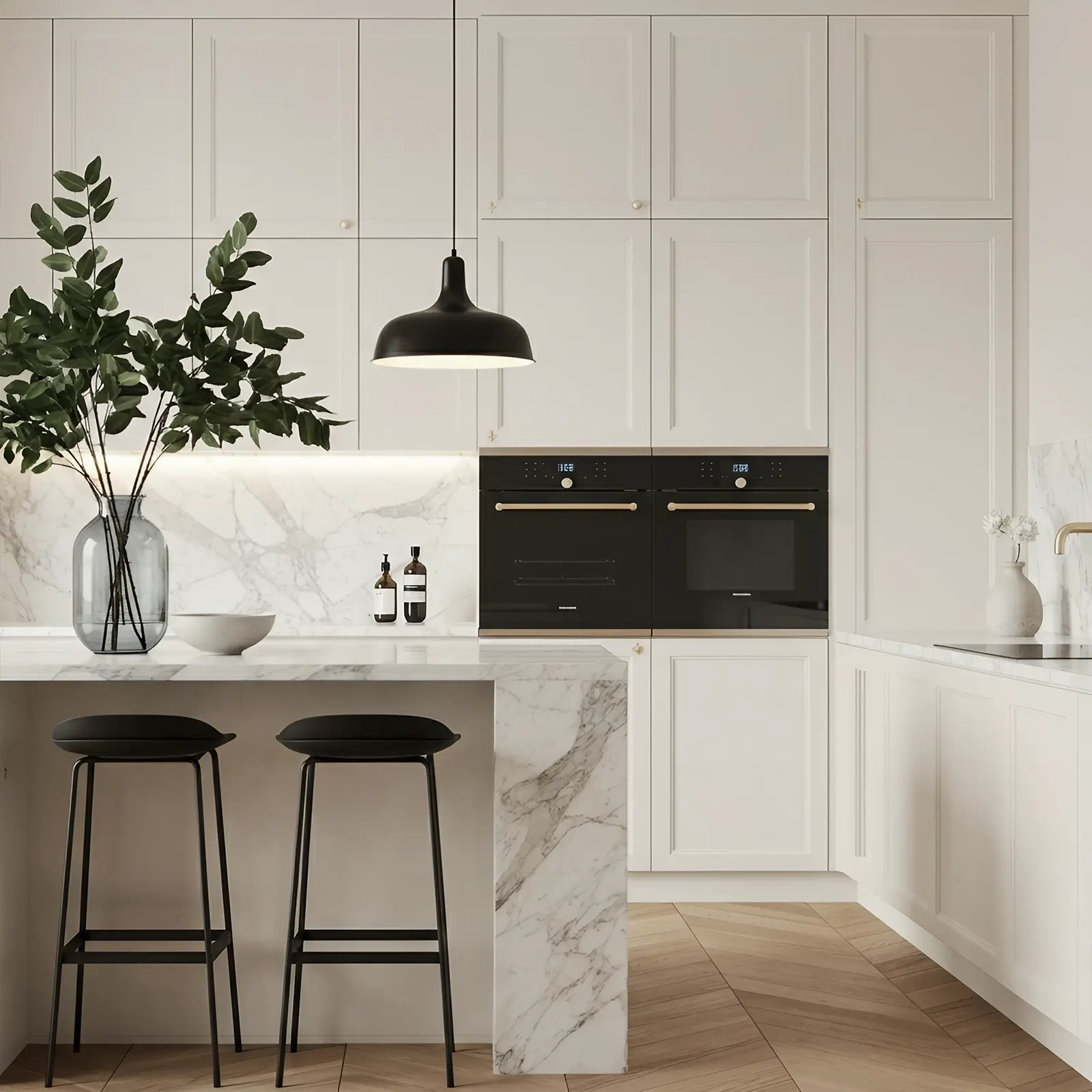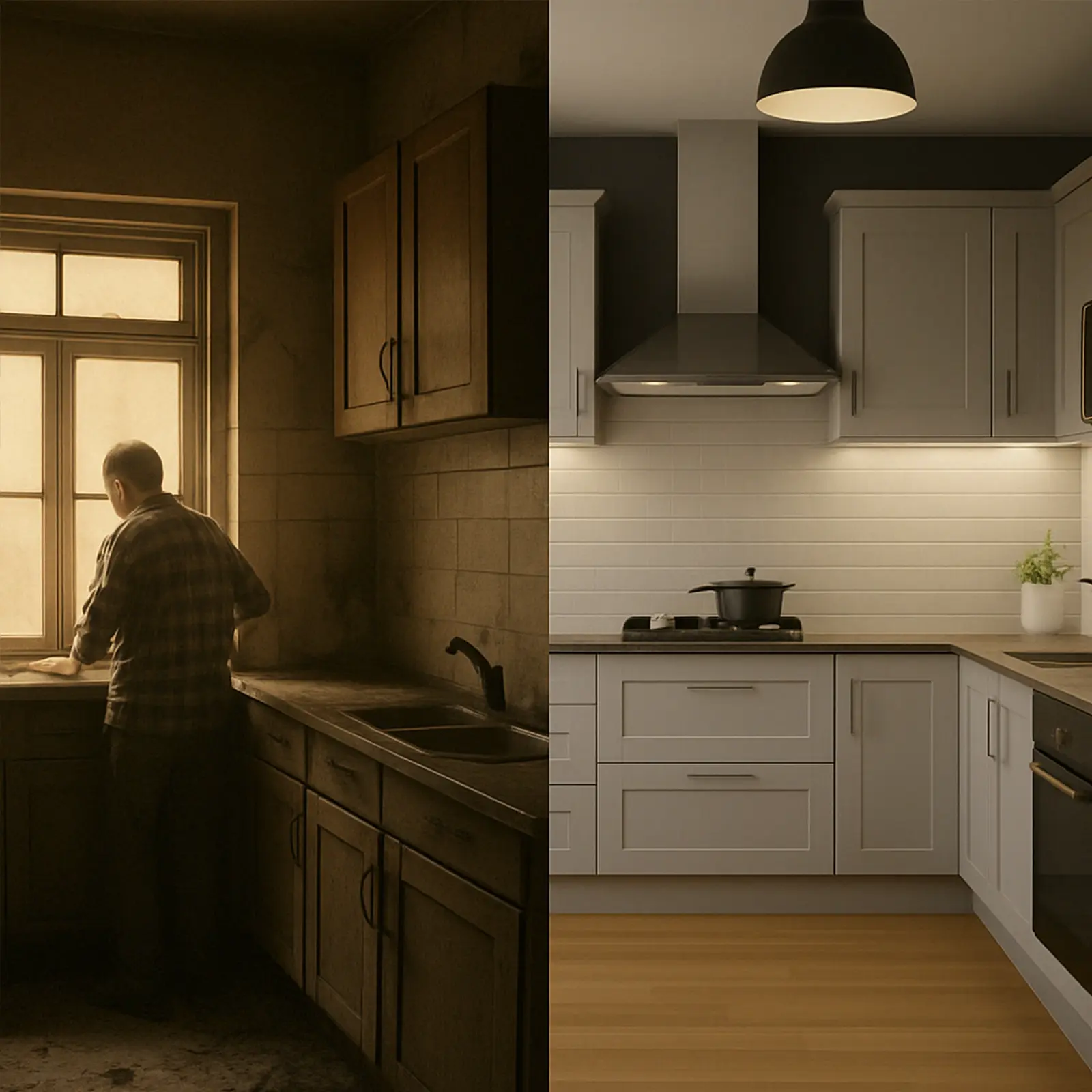
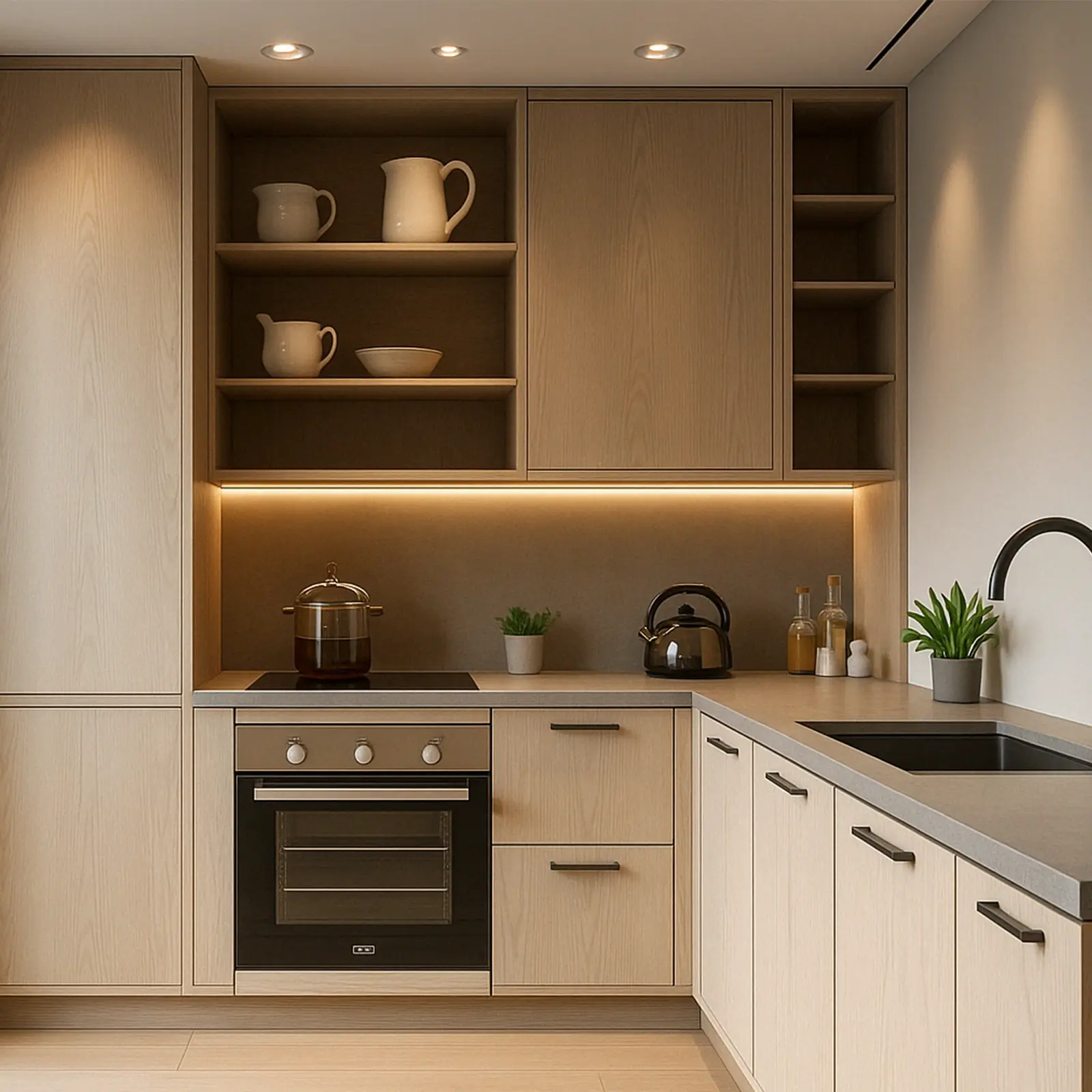
A small kitchen doesn’t mean a bad kitchen. Some of the most functional, visually impressive kitchens we’ve worked on across Sydney’s North Shore have been under 8 square metres. What they had in common wasn’t size. It was good design decisions and a clear plan before anything was ordered or demo’d.
This guide covers everything from realistic cost ranges to storage ideas, layout decisions, and what to expect from the renovation process. If you’re trying to get the most out of a compact kitchen in a Sydney apartment, terrace, or older home, read on.
What Counts as a Small Kitchen in Sydney?
There’s no official definition, but in practice, anything under 10 square metres tends to present the same challenges: limited bench space, not enough storage, and a layout that makes cooking feel more difficult than it should.
Small kitchens are common across a wide range of Sydney properties. You’ll find them in studio and one-bedroom apartments in North Sydney and Neutral Bay, in Federation and terrace homes in Lane Cove and Willoughby, and in older family homes where the kitchen was designed decades before open-plan living became standard.
Typical layouts in apartments and terraces
Galley kitchens run along two parallel walls and are genuinely efficient when designed well. The problem is usually that they feel narrow, and if the walkway is under 900mm, they become uncomfortable for two people to use at once.
L-shaped layouts work well in small open-plan spaces. They give you a natural corner to work with, make good use of space that would otherwise be wasted, and allow for a small dining table or peninsula at the end if the room allows.
One-wall kitchens are the most common in studios and small apartments. They’re the hardest to make feel generous because everything is on a single run, but the right storage choices and appliance selections can make a significant difference.
Common challenges we see in small kitchens
- Bench space that disappears the moment you put a kettle, toaster, and chopping board down
- Storage that’s technically there but hard to access, particularly in overhead cabinets and deep corner cupboards
- Poor natural light, which makes the space feel smaller than it is
- Walkways under 900mm that become frustrating in daily use
- Appliances that were specified for a larger space and now dominate the room
Understanding your layout and its specific limitations is the first step before making any decisions about finishes or fittings.
Explore more kitchen inspiration
How Much Does a Small Kitchen Renovation Cost?
This is almost always the first question, and the honest answer is that it depends on how much of the kitchen you’re changing and what you’re changing it to. That said, here are realistic ranges for Sydney in 2026.
Budget tier: $20,000 to $28,000
At this level you’re typically working with flat-pack or semi-custom cabinetry, laminate benchtops, ceramic tile splashbacks, and standard appliances. The layout usually stays the same, which avoids plumbing and electrical relocation costs. You can get a clean, functional result in this range, but material choices are constrained.
A good benchmark: replacing the benchtop and splashback alone in a small kitchen typically runs $8,000 to $12,000 once you factor in supply, installation, and making good around the edges. Refacing doors rather than replacing full cabinet carcasses can cost $3,000 to $5,000 and gives a visual refresh without a full rip-out.
Standard tier: $28,000 to $45,000
This is where most small kitchen renovations on the North Shore land. At this budget you can expect custom or semi-custom cabinetry, engineered stone benchtops, better appliances, and usually some degree of layout adjustment. Expect some plumbing or electrical work within this range if you’re moving the sink or adding a powerpoint configuration that works for how you actually cook.
Many of the kitchens we complete in Lane Cove and Willoughby sit in this range. You’re getting real quality at this level, not builder’s grade, but not the top-end product either.
Premium tier: $45,000 and above
Custom joinery, stone waterfall benchtops, integrated appliances, hidden rangehood solutions, floor-to-ceiling cabinetry, feature lighting. At this level the kitchen becomes a genuine design statement rather than just a functional room. Some North Shore and Mosman apartments have had kitchens renovated to this standard even at under 7 square metres, because the rest of the home demands it.
What drives the cost up
A few things push a small kitchen renovation higher than homeowners expect:
- Moving the sink. Plumbing relocation in an apartment, particularly in a strata building, can add $2,000 to $5,000 depending on access and building age.
- Electrical upgrades. Older kitchens often don’t have enough circuits for modern appliances. A full electrical upgrade can add $1,500 to $3,000.
- Unexpected asbestos or waterproofing issues. Common in Sydney homes built before 1990. Asbestos removal is a fixed cost that needs to be budgeted if there’s any chance it’s present.
- Appliance selections. The difference between a $600 rangehood and a $3,500 integrated unit matters a lot to the final bill.
For a detailed breakdown of kitchen renovation costs in Sydney, our kitchen renovation cost guide covers current pricing across all tiers and scopes.
If you’re weighing up contract types for your renovation, it’s worth understanding the difference between fixed price and cost-plus contracts before you accept any quote.
How to Maximise Storage in a Small Kitchen
Storage design is where small kitchens either succeed or fail. A kitchen with 7 square metres of floor area and smart storage will function better than one with 12 square metres and poorly designed cabinets.
Ceiling-height cabinetry
The most underused space in most small kitchens is the gap between the top of the overhead cabinets and the ceiling. In a standard 2.7m ceiling home, that’s often 400mm to 500mm of cabinet height that’s been left blank. Extending cabinetry to the ceiling removes that visual break, adds meaningful storage for items you don’t use daily, and makes the room feel taller rather than more cramped.
The trade-off is access. You’ll want a small step stool, and you won’t be reaching those top shelves every day. That’s fine, because they’re the right place for the pasta maker you use twice a year.
Pull-out pantries
A 200mm pull-out pantry next to a fridge or at the end of a run is one of the most practical storage additions in a small kitchen. Everything is visible and accessible. Nothing gets lost at the back of a deep shelf. In a galley kitchen where you don’t have room for a full pantry cupboard, two 200mm pull-outs can hold almost as much as a standard 600mm cabinet while being genuinely easier to use.
Corner systems
Deep corner cupboards are one of the biggest wasted spaces in any kitchen layout. A pull-out Le Mans unit or a simple swing-out carousel costs more than a static corner cabinet, but the usable storage difference is significant. If your existing kitchen has a dark corner cupboard that you haven’t opened in six months, you’ll know exactly what we mean.
Open shelving: the trade-off
Open shelving looks good in photos and has genuine merit in specific situations. It’s easier to access, makes the room feel more open, and gives you a place to display things you actually like looking at.
The downside is that it requires discipline. Shelves in a kitchen collect grease, steam, and dust faster than anywhere else in a home. If you’re not the type to wipe them down weekly and keep them looking organised, open shelving will work against you. A few open shelves alongside closed cabinets is a practical middle ground many clients land on.
Drawer versus door configurations
Standard cabinet doors require you to crouch down and rummage through a dark cupboard to find what’s at the back. Full-height drawers on lower cabinets cost more upfront but give you far better access and visibility. For a small kitchen where every item needs to be easy to reach, the upgrade from door to drawer configuration is usually worth it.
Read our guide on how to avoid common kitchen renovation mistakes
Smart Layout Ideas for Small Kitchens
Layout is the one thing you can’t easily change once the renovation is done. Getting it right matters more than almost any other decision.
The kitchen work triangle still applies
The principle that your fridge, sink, and cooktop should form a triangle with reasonable distances between them is old but still valid. The numbers that work well in a small kitchen: between 1.2m and 2.7m between each point of the triangle, with a total perimeter of no more than 7.9m. Below those distances and you’ll feel cramped. Above them and you’ll be doing more walking than cooking.
Galley versus L-shaped versus one-wall: how to decide
Galley works best when you have a longer, narrower room with at least 1m of clear walkway between the two runs. If your room is less than 2.4m wide, a galley only works with one run, which makes it a one-wall kitchen by default.
L-shaped is the most versatile for small rooms that have a corner to work with. It gives you natural separation between prep and cooking zones, and a well-placed corner unit can maximise storage. For rooms that open to a living or dining area, the L-shape also works well visually.
One-wall is a constraint, not a choice, in most cases. If it’s what you have, the priorities are maximising linear storage, being strategic about where the sink sits relative to the cooktop, and considering whether a small freestanding island or peninsula is possible given the room dimensions.
Islands and peninsulas in small kitchens
A full kitchen island needs at least 1m of clear circulation space on all sides to be comfortable. In most small Sydney kitchens, that means a minimum room width of about 3.2m is needed before an island becomes practical. Below that, the island either blocks flow or becomes impractical to use.
A narrow peninsula (typically 400mm to 500mm deep) attached to one end of an L-shaped run is a much better option in tighter spaces. It adds bench space, creates a natural breakfast bar if height allows, and doesn’t block the room. In some Lane Cove and Neutral Bay apartments we’ve worked in, a 500mm peninsula has made the difference between a kitchen that feels complete and one that always felt like something was missing.
Layout changes and approvals
If you’re moving walls, relocating the sink, or making structural changes, you may need a CDC (Complying Development Certificate) or Development Application depending on your local council and property type. Our guide to DA versus CDC approvals explains which pathway applies and how to navigate it.
Materials and Finishes That Make Small Kitchens Feel Bigger
Finishes do a lot of work in a small kitchen. The right choices make the space feel considered and open. The wrong ones make it feel busy and cramped.
Cabinetry finishes
Gloss cabinetry reflects light and makes the room feel brighter. The trade-off is that fingerprints show and it can feel dated in a few years if the colour choice is too trend-driven.
Matte finishes have been the dominant preference in Sydney’s North Shore market for the past few years and remain popular in 2026. They photograph well, hide marks better than gloss, and suit a range of benchtop pairings.
Colour matters more in a small kitchen than in a large one. In 2026, the most popular choices in the kitchens we’re completing are warm whites, sage greens, natural beiges, and sand tones. These work well with timber hardware and stone benchtops. Very dark cabinetry can work beautifully in a small kitchen when the lighting is good, but it needs to be handled carefully or it will make the space feel smaller.
Benchtops
Engineered stone (Silestone, Caesarstone, and similar brands) remains the default choice for good reason. It’s hard-wearing, easy to clean, consistent in appearance, and available in a wide range of colours. In a small kitchen, a continuous stone run with no visible joins looks cleaner than a benchtop that’s been pieced together.
Waterfall benchtops, where the stone continues down the side of a cabinet or peninsula, give a sense of substance and finish to a small kitchen without adding visual clutter. They work particularly well on peninsulas.
Laminate is a genuine option at the budget end. Today’s laminate is far better than it was ten years ago, and in a rental or investment property renovation, the price point makes sense. For an owner-occupier renovation where you’re staying put for years, the step up to stone is usually worth it.
Splashbacks
White subway tiles remain a reliable, timeless choice. They work with almost everything and won’t look dated in five years.
Mirrored splashbacks are worth considering in a very dark or north-facing kitchen. They bounce light around the room more effectively than any other splashback material. The limitation is that they show water marks and require regular cleaning.
Stone or porcelain slab splashbacks that match the benchtop give a clean, continuous look that works well in small kitchens. No grout lines, easy to clean, and the visual simplicity makes the space feel calmer.
Flooring and lighting
Light-coloured flooring, whether vinyl, tile, or engineered timber, makes a small kitchen feel larger by reducing the visual weight of the floor plane. Dark floors can work but need to be balanced with lighter walls and cabinetry.
Under-cabinet LED strip lighting is not optional in a small kitchen where overhead cabinets reduce natural light on the bench surface. Recessed downlights positioned over the main prep and cooking zones, plus under-cabinet strips, gives you layered light that makes the kitchen both functional and visually appealing.
Timeline: How Long Does a Small Kitchen Renovation Take?
One of the questions we get asked more than almost any other. Here’s a realistic breakdown for a small kitchen renovation in Sydney.
Design and planning: 2 to 4 weeks
This covers the initial brief, cabinetry design, appliance and material selections, and pricing. If you need a CDC or DA, add 4 to 8 weeks for approval on top of this. Most small kitchen renovations in Sydney don’t require a DA unless structural or significant plumbing changes are involved.
Pre-construction: 1 to 2 weeks
Once you’ve accepted the quote and signed the contract, your builder orders materials. Lead times on cabinetry from most Sydney suppliers currently sit between 3 and 6 weeks, so the earlier selections are made, the better. Benchtop stone is usually measured after cabinet installation and takes about 10 to 14 days to fabricate.
Construction: 2 to 5 weeks
For a straightforward small kitchen renovation (same layout, no structural changes), expect 2 to 3 weeks of active construction: demo, cabinetry installation, plumbing, electrical, benchtops, splashback, and finishing. If you’re reconfiguring the layout, moving plumbing, or addressing any unexpected issues behind the walls, allow 4 to 5 weeks.
Finishing and handover: 1 week
Touch-ups, hardware installation, appliance commissioning, and final clean. This is often the phase that homeowners underestimate in terms of how much difference getting it right makes to the final result.
Total typical timeline: 6 to 12 weeks from brief to handover, depending on the scope. The biggest variable is usually decisions. Projects where the client makes selections promptly and doesn’t change their mind mid-construction are almost always faster and smoother.
Budget-Friendly Upgrades That Make an Impact
Not every small kitchen renovation needs to be a full replacement. These targeted upgrades deliver the most visual and functional impact per dollar spent.
Reface instead of replace
If your cabinet carcasses are in good condition and the layout works, replacing just the doors and drawer fronts is a cost-effective way to refresh the kitchen. Expect to pay $3,000 to $5,000 for door and drawer front replacement in a small kitchen, compared to $15,000 to $20,000 for full new cabinetry. The result isn’t the same, but if budget is the constraint, it’s a sensible approach.
Benchtop and splashback replacement
New engineered stone benchtops and a fresh splashback in a small kitchen typically costs $8,000 to $12,000 all in, including supply, fabrication, installation, and making good. This upgrade alone changes the character of the kitchen significantly, especially if you’re going from a tired laminate bench to stone.
Hardware and tapware
New cabinet handles and a new sink mixer are low-cost upgrades that make an outsized visual difference. Budget $500 to $1,500 for hardware and $400 to $1,200 for quality tapware. These are changes most homeowners can notice immediately.
Under-cabinet lighting
Adding LED strip lighting under overhead cabinets costs $800 to $1,500 fully installed and transforms the functional experience of a dark kitchen. It’s one of the most cost-effective upgrades available.
Read: The High Price of Low-Cost Renovations
Real-World Small Kitchen Examples from Sydney Homes
These aren’t invented scenarios. They’re representative of the types of projects we handle regularly across Sydney’s North Shore.
Lane Cove apartment kitchen
A cramped L-shaped kitchen in a two-bedroom apartment, roughly 6.5 square metres. The existing overhead cabinets were at standard height, leaving a 450mm gap to the ceiling. Storage was inadequate for the couple who lived there full-time.
The renovation extended cabinetry to ceiling height, replaced the standard cabinet door and drawer fronts with a warm white matte finish, added a pull-out 200mm pantry beside the fridge, and replaced the laminate benchtop with Caesarstone in a warm grey. New LED strips under the overhead cabinets and updated tapware completed the work.
Total cost: approximately $28,000. Timeline: 4 weeks from cabinetry delivery to handover.
North Sydney studio kitchen
A one-wall kitchen in a studio apartment with roughly 3m of run. The challenge was fitting a fridge, cooktop, oven, sink, and meaningful storage into that linear space while leaving the living area feeling open.
The solution was a slim, floor-to-ceiling vertical pantry at the far end of the run, integrated appliances to maintain a clean visual line, and open shelving replacing one section of overhead cabinets to avoid a closed-in feel. Pale matte cabinetry and a continuous porcelain slab splashback kept the space feeling light.
Total cost: approximately $22,000. Timeline: 3 weeks.
Willoughby terrace kitchen
An older terrace home with a U-shaped kitchen that had been closed off from the rest of the ground floor. Removing a non-structural wall and converting to an open L-shaped layout with a small peninsula changed the character of the entire ground floor.
Natural stone benchtops, a mirrored splashback that bounced light from the adjacent window, and sage green cabinetry with brushed brass hardware made it a kitchen the clients now describe as the best room in the house.
Total cost: approximately $41,000, including wall removal and making good. Timeline: 6 weeks.
Explore more renovation inspiration
Frequently Asked Questions About Small Kitchen Renovations
How much does a small kitchen renovation cost in Sydney?
Most small kitchen renovations in Sydney fall between $28,000 and $45,000 for a full replacement at standard quality. Budget renovations using flat-pack cabinetry and laminate can come in at $20,000 to $28,000. Premium custom joinery with stone and integrated appliances typically starts at $45,000 and can go considerably higher depending on selections.
The variables that move the number most are whether you’re changing the layout (which involves plumbing and electrical relocation), the appliance selections, and the cabinetry quality. Our kitchen renovation cost guide breaks down current Sydney pricing in more detail.
How long does a small kitchen renovation take?
From first brief to handover, expect 6 to 12 weeks for a straightforward small kitchen renovation. That includes 2 to 4 weeks for design and selections, 3 to 6 weeks for the cabinetry lead time and construction, and 1 week for finishing and handover. Renovations that involve layout changes, plumbing relocation, or any approvals will take longer.
The most common cause of delay isn’t the builder. It’s decisions. Every week spent deliberating over benchtop colour or handles adds a week to the timeline.
What is the best layout for a small kitchen?
It depends on the room shape and dimensions, but for most small Sydney kitchens, an L-shaped layout makes the best use of available space. It gives natural work zones, suits open-plan living, and allows for a peninsula if the room is wide enough. Galley layouts work well in longer, narrower rooms where you have at least 1m of clear walkway between the two runs.
Can you put an island in a small kitchen?
A full island needs at least 1m of clear space on all sides to be functional. In most small kitchens, the room simply isn’t wide enough. A narrow peninsula (400mm to 500mm deep) attached to an L-shaped run is a much better option. It adds bench space and can serve as a breakfast bar without blocking circulation.
How do you make a small kitchen look bigger?
Light-coloured or gloss cabinetry reflects more light and makes the room feel more open. Extending cabinetry to the ceiling height removes the visual break and adds height. Under-cabinet LED strips eliminate shadows on the bench surface. Keeping the splashback and benchtop in similar tones reduces visual complexity. And minimising the number of visible items on the bench is probably the most underrated factor.
What’s the best benchtop for a small kitchen?
Engineered stone is the best all-around choice for most small Sydney kitchens. It’s durable, consistent, available in a wide range of colours, and looks good at most budget levels. In a small kitchen, a continuous stone run without visible joins looks clean and considered. If budget is the binding constraint, modern laminate is genuinely better than it was a decade ago and is a reasonable choice for a rental or investment property.
Should I keep my existing layout?
If the existing layout works reasonably well and the primary issues are condition and aesthetics, keeping the layout saves significant money. Moving the sink in an apartment can add $2,000 to $5,000 once plumbing and strata requirements are factored in. Moving the cooktop usually means relocating gas or electrical connections, which adds cost and time.
If the existing layout genuinely doesn’t function, the cost of changing it is often worth it. But many kitchens that feel like they have a layout problem actually have a storage problem, which is far cheaper to solve.
Is it worth renovating a small kitchen?
Almost always, yes. A well-executed small kitchen renovation improves the daily experience of living in a home significantly. It also has strong resale value implications, particularly in apartment-heavy areas like North Sydney, Neutral Bay, and Lane Cove where kitchen quality is something buyers assess closely.
The risk is over-capitalising, meaning spending significantly more on the kitchen than the property’s value supports. Getting an independent property perspective before finalising your budget is worth doing for investment properties. For a home you plan to live in for years, the lifestyle return from a functional, well-designed kitchen is hard to put a number on.
Before starting any renovation, it’s worth understanding your rights as a homeowner. NSW Fair Trading publishes guidance on home building contracts and what licensed builders are required to provide. The Housing Industry Association also publishes useful resources on residential construction standards and what to expect from the renovation process.
For guidance on what to look for in a builder before you sign anything, our building contract checklist is worth reading alongside this post. And if you’re thinking about how to approach the renovation planning process from the start, early builder involvement is something we think makes a real difference to how projects run.
Ready to Reimagine Your Kitchen?
A small kitchen, done well, can be the best room in your home. The kitchens that work best aren’t the largest ones. They’re the ones where every decision was made with function and flow in mind from the start.
At LikeSilk Building, we’re a family-run team on Sydney’s North Shore. We manage the entire renovation process end-to-end, from initial brief through design, approvals, construction, and handover, under licence 274849C. We don’t hand you off at any point in the process.
If you’re thinking about renovating a small kitchen and want a clear conversation about what’s involved, what it’s likely to cost, and how long it will take, book your free kitchen renovation planning call.
You can also download our Renovation Blueprint for a step-by-step guide to planning any Sydney renovation, or explore our kitchen renovation service page to see how we work.
Related reading