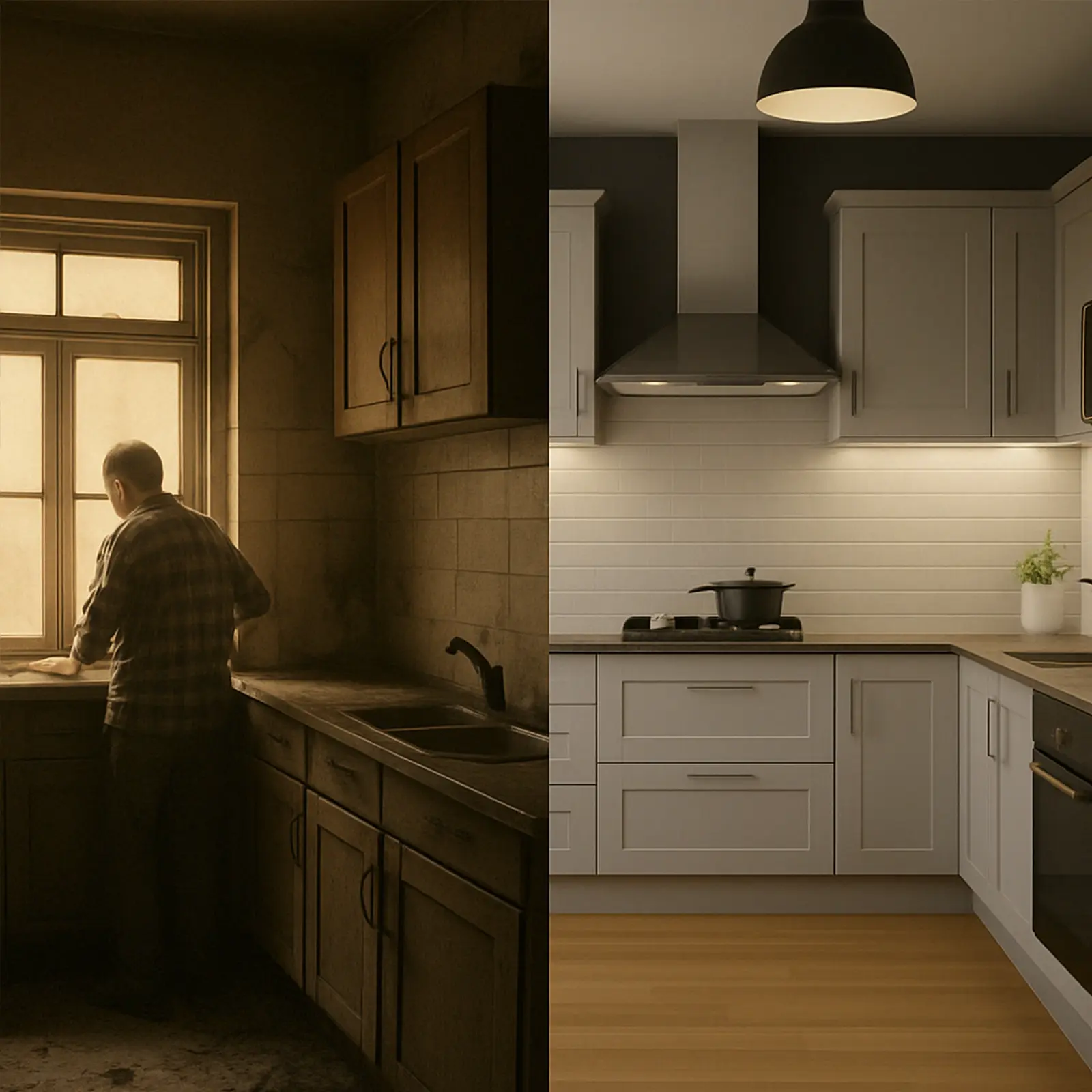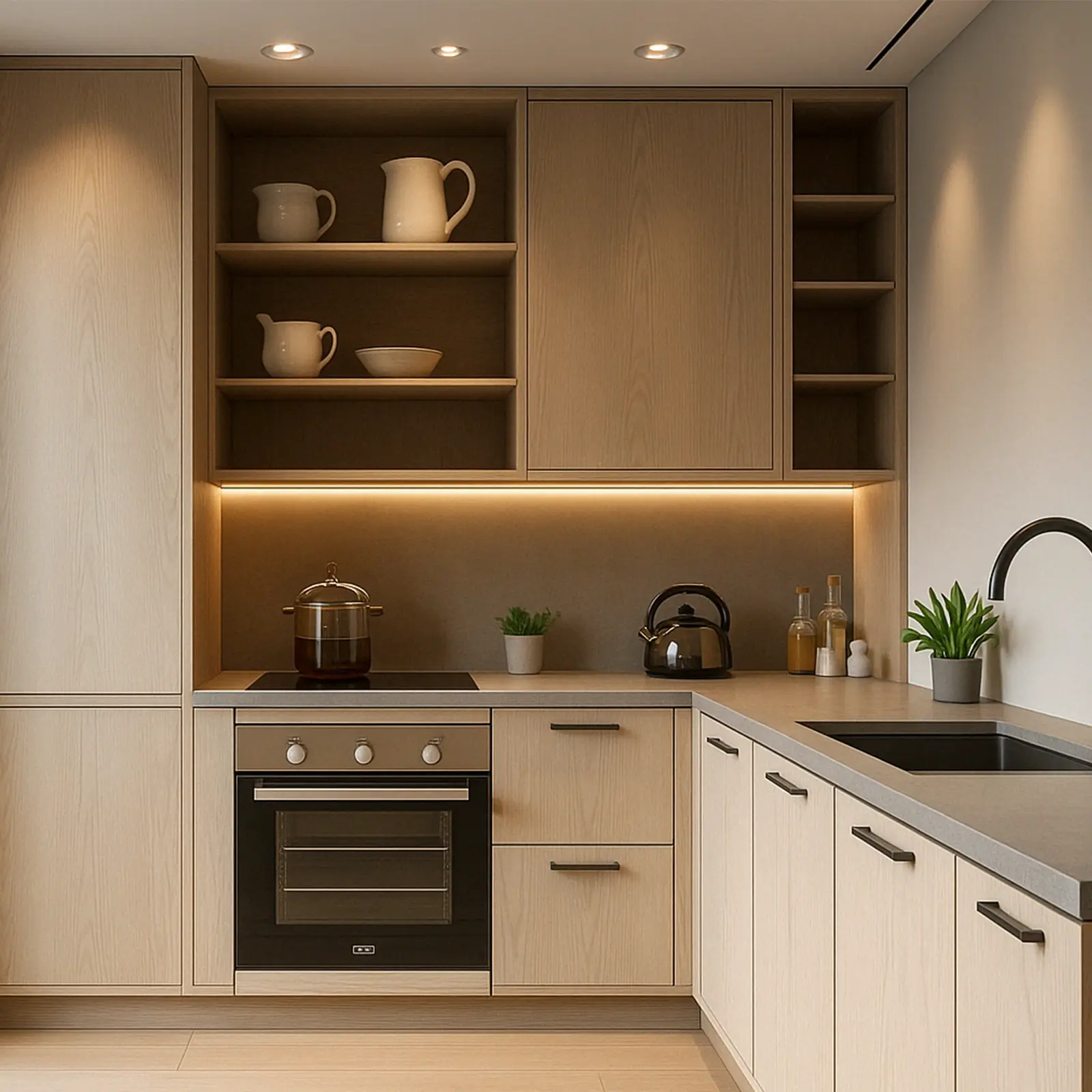
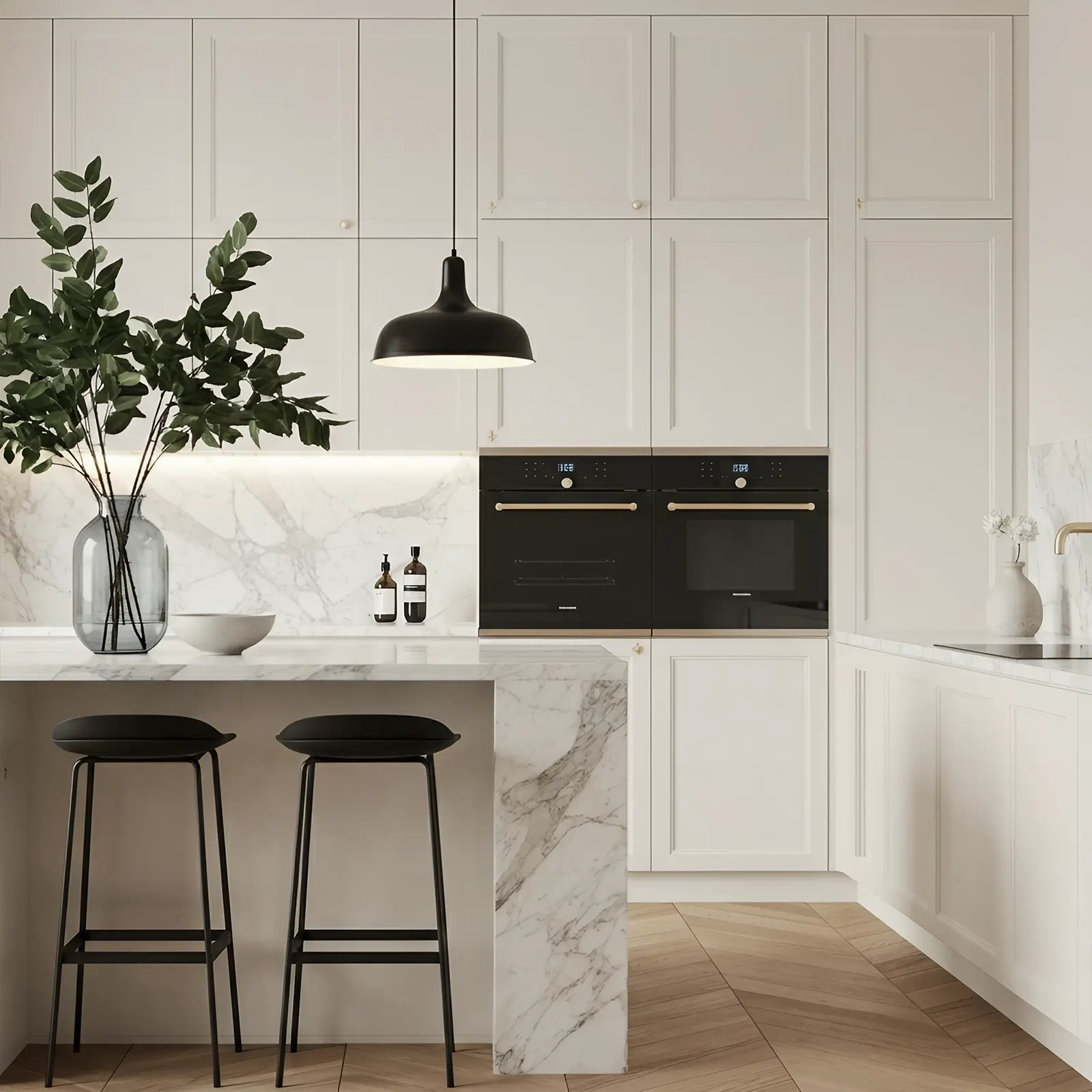
If you’re trying to figure out what a kitchen renovation will actually cost in Sydney, you’ve probably already noticed that the numbers online vary wildly. That’s not because people are hiding something. It’s because two kitchens that look similar on paper can cost $20,000 apart depending on layout, materials, and who’s doing the work.
This guide gives you real numbers for Sydney’s North Shore market in 2026, broken down by category, tier, and trade. We’ll also cover what’s changed this year, where the hidden costs tend to land, and how to tell a solid quote from one that’ll cause you problems later.
Kitchen Renovation Cost Ranges in Sydney
Sydney kitchen renovations fall into three broad tiers. Here’s what each one actually gets you:
Budget kitchen renovation: $35,000 to $45,000
New cabinetry, laminate or entry-level engineered stone benchtops, mid-range freestanding appliances, updated splashback and lighting. The layout stays exactly as it is. This is a meaningful upgrade, not a full transformation, but it can make a tired kitchen feel completely current.
Mid-range kitchen renovation: $45,000 to $60,000
This is where most North Shore renovations land. Custom or semi-custom joinery, engineered stone benchtops, integrated appliances, quality hardware, new flooring, and often some reconfiguration within the existing footprint. The difference between a $45K and a $60K mid-range kitchen is mostly in the quality of the cabinetry and appliances, not the scope.
High-end kitchen renovation: $60,000 to $90,000+
Bespoke cabinetry built to the millimetre, premium natural stone or porcelain benchtops, fully integrated top-tier appliances, and usually structural work like opening a wall or relocating services. In areas like Mosman, Cremorne, and Northbridge, this tier is common because the property values support it.
These figures include labour, materials, and project management. They do not include architect or separate kitchen design fees if you’re using external professionals.
Cost Breakdown: Where Your Money Goes
Here’s a real breakdown of a mid-range Sydney kitchen renovation ($40,000 to $60,000):
Cabinetry: $12,000 to $20,000 (30 to 35% of total budget) Custom or semi-custom joinery, soft-close hardware, quality internal fittings. This is typically the single largest line item.
Benchtops: $3,000 to $8,000 (8 to 15% of budget) Engineered stone is the most common choice at this level. Expect to pay more for natural stone or porcelain at the higher end.
Appliances: $5,000 to $10,000 (12 to 18% of budget) Quality mid-range brands. Integrated rangehood and dishwasher are increasingly standard in this tier.
Electrical and plumbing: $4,000 to $8,000 (10 to 15% of budget) New power points, lighting circuits, plumbing connections. Significantly more if you’re relocating services.
Splashback: $1,000 to $3,500 (3 to 6% of budget) Tiles, glass, or stone. Subway tiles at the budget end, full-height stone at the premium end.
Lighting: $1,500 to $3,500 (3 to 6% of budget) Under-cabinet LEDs, pendants, downlights. Lighting has an outsized effect on how a kitchen feels.
Flooring and tiling: $2,500 to $6,000 (6 to 10% of budget) Often extends into adjacent living areas for continuity.
Labour and project management: $10,000 to $18,000 (25 to 30% of budget) Site preparation, trade coordination, supervision, and cleanup. This covers the builder holding the whole job together.
What Affects Kitchen Renovation Cost in Sydney
Layout Changes
Keeping your existing layout is the single biggest lever on cost. Moving the sink adds $2,000 to $5,000 for a plumber. Moving the cooktop, if it’s gas, adds similar or more for gas-fitting and ventilation changes. Moving the fridge position means rerouting power and potentially adjusting cabinetry runs.
None of these changes are unreasonable. They just need to be budgeted for properly. If your kitchen doesn’t work functionally, spending $40K to put new finishes on a bad layout is money not well spent. If your layout is fine and you just want it to look better, keep everything where it is.
For smaller kitchens where layout efficiency is the main challenge, our guide on small kitchen renovation ideas for Sydney homes covers how to get more out of a limited footprint without necessarily moving everything.
Cabinetry
Cabinetry accounts for 30 to 40% of most kitchen renovation budgets in Sydney. The range is significant:
Flat-pack: $3,000 to $6,000 Functional, budget-friendly, limited customisation. Fine for investment properties or very tight budgets where the goal is clean and functional, not impressive.
Semi-custom joinery: $8,000 to $15,000 The sweet spot for most renovations. Good quality, reasonable flexibility, handles standard layouts well.
Fully custom cabinetry: $15,000 to $25,000+ Worth it for unusual spaces, specific storage requirements, or high-end finishes. Solves problems that flat-pack and semi-custom simply can’t, including awkward corners, ceiling-height runs, and integrated appliance pockets.
Benchtops
For a typical Sydney kitchen with 3 to 5 square metres of benchtop:
Laminate: $400 to $600 per m2 ($1,200 to $3,000 total) Durable, wide colour range, budget-friendly. Modern laminates look significantly better than they did ten years ago.
Engineered stone: $700 to $1,200 per m2 ($2,100 to $6,000 total) The most popular choice in 2026. Consistent colour, low maintenance, available in everything from marble-effect to concrete-look.
Natural stone: $1,200 to $2,000+ per m2 ($3,600 to $10,000+ total) Unique patterns, premium feel. Requires sealing and more careful maintenance.
Porcelain: $1,100 to $1,800 per m2 ($3,300 to $9,000 total) Gaining popularity quickly. Heat and scratch resistant, very thin profile is possible.
Appliances
You can supply your own appliances or include them in the renovation quote. Typical ranges:
Budget package: $3,000 to $5,000 Functional mid-market brands. Gets the job done.
Mid-range: $5,000 to $10,000 Quality brands with better performance and aesthetics.
Premium or integrated: $10,000 to $20,000+ Fully integrated behind cabinet panels. Creates a seamless look that’s become expected in higher-end Sydney kitchens.
Sydney Labour Premium
Labour in Sydney runs 30 to 40% above the national average. It typically accounts for 35 to 50% of your total kitchen renovation cost, often the single largest cost category when you combine all trades.
A kitchen renovation pulls in multiple trades: cabinetmakers, plumbers, electricians, tilers, painters, and sometimes a builder for structural work. Coordinating these trades properly, keeping the job moving, avoiding downtime when one trade finishes and another needs to start, is a real skill. It’s a big part of what we manage throughout the renovation process.
2026 Price Update: What’s Changed
If you’ve been researching kitchen renovation costs for a while, here’s where the numbers have moved:
Prices are up 5 to 10% from 2025. Labour costs continue to increase, and engineered stone in particular has seen price pressure from supply chain issues.
Engineered stone is still the most popular benchtop choice but expect to pay $700 to $1,200 per m2, up from $650 to $1,000 in 2025.
Shaker-style cabinetry and matte finishes are dominating North Shore renovations. Safe choices that work with a wide range of aesthetics and hold up over time without feeling dated.
Integrated appliances are now standard at the mid-range tier. What was a luxury inclusion a few years ago is now expected in the $50K+ bracket.
Lead times have improved. Custom joinery that took 8 to 12 weeks in 2023 to 2024 is back to 6 to 8 weeks for most manufacturers.
Cost Per Square Metre: The Quick Calculation
A common question is “what does a kitchen renovation cost per square metre?” It’s a useful starting point, but comes with real limitations.
For a quality renovation in Sydney in 2026, expect $2,500 to $4,500 per square metre. A 12m2 kitchen at mid-range finishes works out to roughly $30,000 to $54,000.
The problem is that cost-per-m2 is a blunt instrument. A small kitchen often costs more per square metre than a large one, because you still need a full set of trades and a minimum number of appliances regardless of how compact the space is. Access constraints in apartments and strata buildings add cost that square metreage doesn’t capture. And the same 12m2 footprint can cost $35K with laminate finishes or $85K with bespoke cabinetry and natural stone.
Use cost-per-m2 as a sanity check, not a quote substitute. A number that sits well outside the $2,500 to $4,500 range in either direction is worth questioning.
Will You Get Your Money Back? ROI and Resale Value
For most Sydney homeowners, a kitchen renovation is both a quality-of-life investment and a financial one. The question worth asking honestly is: how much will you recover when you sell?
The generally accepted range for kitchen renovation ROI in Australia is 60 to 80% recovery of renovation cost in property value uplift. In premium Sydney suburbs, that can reach 90% or higher.
What does that look like in practice? A $45,000 kitchen renovation in a Mosman home adds roughly $27,000 to $40,500 in market value. That’s not dollar-for-dollar, but it’s a meaningful return, especially when combined with the daily quality-of-life benefit you get in the years you’re still living there.
A useful rule of thumb used by property advisors is that renovation spend should not exceed 5% of the home’s current value for a single room. On a $2M home, that points to a $100,000 total renovation budget as a ceiling before you risk over-capitalising. For a kitchen specifically, 2 to 3% of home value is a reasonable upper bound.
When ROI matters most: If you’re renovating within 12 months of selling, focus on kitchens and bathrooms. Real estate agents consistently identify these as the highest-impact rooms for buyer perception. If you’re renovating to live in the home for five or more years, the daily enjoyment factor is arguably more important than the eventual return.
When ROI matters less: If your kitchen is genuinely dysfunctional, outdated, or a real deterrent to buyers, renovating it before sale may be less about ROI and more about removing a negative. A kitchen that turns buyers off can cost you more in negotiations than the renovation would have.
For a broader look at whether a renovation will pay off, the bathroom renovation cost guide covers similar ROI considerations for the other room buyers scrutinise most.
Hidden Costs and What’s NOT Included
Most builders quote the visible work. Here’s what can add cost that you might not see coming:
Design and documentation fees. If you use an external kitchen designer or architect, that’s typically $2,000 to $8,000 on top of the build cost. Some builder-led renovation processes include design within the project scope. Ask upfront.
Structural engineering. If you’re removing a wall (particularly a load-bearing one), you’ll need a structural engineer’s report and potentially council approval. Budget $1,500 to $3,500 for the engineering report alone.
Council or strata application fees. CDC applications typically cost $500 to $2,000 in assessment fees. DA applications cost more and take longer. Strata applications vary by scheme.
Asbestos removal. Homes built before 1990 may have asbestos in wall sheeting, floor adhesives, or ceiling tiles. Testing costs around $300 to $500. Removal, if needed, is $1,500 to $5,000+ depending on extent and how it’s bonded.
Temporary kitchen setup. You won’t have a functional kitchen for most of the renovation. Factor in microwave meals, takeaway, a bar fridge, and a portable induction cooktop. Budget at least $500 to $1,500 for this.
Post-renovation work. Touch-up painting in adjacent areas, new window furnishings, extra electrical points that weren’t in scope. Small items, but they add up.
A 10 to 15% contingency buffer on top of your quoted price is sensible planning for any renovation. With a properly scoped fixed-price quote, you shouldn’t need to dip into it, but having it removes a lot of anxiety.
Budget Kitchen Renovations: How to Save Without Regretting It
If you want maximum impact for minimum spend, here’s where to focus:
Keep the layout. Non-negotiable for a budget renovation. Moving plumbing and electrical adds $5,000 to $10,000 that you won’t see in the finished product.
Mix your materials strategically. Invest in the benchtop, you touch it daily and it dominates the visual. Save on cabinetry with semi-custom options that look just as good from the outside.
Use classic splashbacks. Subway tiles at $50 to $80 per square metre look timeless and cost a fraction of custom glass or stone. The alternatives photograph beautifully on Instagram and age less well in a real kitchen.
Choose quality mid-range appliances. A $1,500 oven performs almost identically to a $4,000 one for most home cooking. Spend more on the rangehood if anything, since it’s the thing that genuinely affects how you live in the kitchen every day.
Consider open shelving on upper cabinets. Replacing some upper cabinets with shelves reduces joinery cost and opens up the space visually. Not for everyone, but effective if you’re tidy and know you’ll keep it looking good.
Leave the flooring if it’s in good condition. A professional clean or polish can save thousands if the existing floor has life left in it.
The thing to watch out for is the false economy of going too cheap. We see it often. The cheapest quote comes with cheap inclusions, or the scope is narrower than you realise, and the variations start arriving mid-build. Our post on the real cost of low-cost renovations covers exactly how this plays out.
What It’s Actually Like Living Through a Kitchen Renovation
This matters more than most budgeting guides acknowledge.
Timeline: Most kitchen renovations take 3 to 6 weeks once work starts on site. Add 2 to 4 weeks upfront for design finalisation, ordering, and any approvals.
The reality: You won’t have a functioning kitchen for most of that time. No sink, no cooktop, no oven. Some clients take it in their stride. Others find it far harder than they expected.
How to manage it:
- Set up a temporary kitchen before work starts: kettle, microwave, bar fridge, portable induction cooktop
- Meal prep and freeze meals in advance
- Budget for more takeaway than you think you’ll need
- If you work from home, be honest about how demolition and noise will affect your days
We can often phase the work to keep the sink functional longer, or schedule demolition while you’re away. It’s worth raising this early with your builder, not as an afterthought.
The disruption is real and temporary. Most clients find it more manageable than they expected when they knew exactly what was coming and when.
Council or Strata Approval for a Kitchen Renovation in Sydney
Private Homes
No approval typically required for:
- Replacing cabinetry and benchtops
- New appliances
- Cosmetic updates (paint, splashbacks, lighting)
- Like-for-like replacements
May need CDC or DA approval for:
- Removing or modifying walls, especially load-bearing
- Moving plumbing more than around a metre
- Changing the kitchen footprint
- Adding windows or altering external walls
Our guide to DA vs CDC approvals explains the difference and which pathway is likely to apply to your project.
Apartments and Strata Properties
You’ll almost always need written strata approval before any work begins, including cosmetic work in many schemes.
Typical strata requirements:
- Written approval from the owners corporation
- Restricted working hours, often 8am to 5pm weekdays only
- Lift booking for material delivery
- Protection of common areas
- Compliance with waterproofing standards
- Sometimes additional insurance requirements
Start the strata approval process 4 to 8 weeks before you want to begin. It’s the thing that most catches apartment owners off guard.
NSW Fair Trading’s renovation guide covers the legal requirements for both owners and tenants in NSW.
How to Get Accurate Quotes (and Spot the Bad Ones)
Getting multiple kitchen quotes is smart. Comparing them properly is harder than it looks, because most of the real difference between quotes hides in places the headline number does not show: PC allowances for joinery and appliances, vague exclusions, missing trades (electrical, plumbing, tiling), and unclear variation rates. A $38,000 quote and a $54,000 quote for what looks like the same kitchen are almost never the same kitchen.
For the full decision framework including a worked example of three quotes for the same job, read our guide on how to compare renovation quotes. Our guide to fixed price vs cost-plus contracts covers the contract structures you will be asked to sign, 10 questions to ask your builder before engaging covers the vetting stage that sits before quotes, and our building contract checklist covers what to verify before signing anything.
A separate but related point worth knowing: there is a meaningful difference between engaging a builder who only shows up to build, and one who is involved from the beginning when decisions are still cheap to change. We have written about why early builder involvement matters if you want to understand how that changes the process. And if your kitchen project also takes in an adjoining laundry or scullery, our guide to laundry renovation ideas and costs covers what to budget for that space.
How LikeSilk Building Prices Kitchen Renovations
LikeSilk Building is a family-run building company on Sydney’s North Shore. We work across kitchens, bathrooms, and interior renovations for homeowners who want the job done properly without the chaos that often comes with it.
The way we price projects is straightforward. Once we’ve properly scoped your kitchen, you get a detailed proposal showing exactly where your money goes: cabinetry, benchtops, appliances, each trade, and project management listed separately. No lump sums that hide the detail.
We offer both fixed-price and cost-plus contracts depending on the project. For most kitchens where the scope is clear, a fixed-price contract gives you the certainty of knowing what you’re committing to before work starts.
What we won’t do is give you a low number to win the job and then add variations. If we see something in the design that’s going to cost more than the budget allows, we’ll say so before you’re locked in, not after. That’s the difference between a builder who manages the experience and one who just manages the build.
We’re a licensed builder (Licence 274849C), HIA member, and all projects over $20,000 in NSW are covered by the Home Building Compensation Fund. That insurance protects you if a builder becomes insolvent or fails to complete the work. It’s not optional, but it’s worth knowing it’s in place.
For a full picture of how our kitchen renovation service works, see the kitchen renovations page.
Common Cost Questions Answered
How much does a kitchen renovation cost in Sydney?
Most Sydney kitchen renovations fall between $25,000 and $90,000+, depending on scope, materials, and whether you’re changing the layout. Budget renovations land at $25K to $40K. Mid-range renovations, which are the most common on the North Shore, sit at $40K to $60K. High-end renovations with bespoke cabinetry and structural changes run $60K to $90K or more.
What’s the average kitchen renovation cost per square metre in Sydney?
Expect $2,500 to $4,500 per square metre for a quality renovation in 2026. A 12m2 kitchen at mid-range finishes works out to roughly $30,000 to $54,000. Small kitchens often cost more per square metre because the baseline trade costs stay similar regardless of size.
How much does a small kitchen renovation cost in Sydney?
A small kitchen under 10m2 typically costs $28,000 to $45,000 in Sydney. Smaller doesn’t automatically mean cheaper. Labour and access costs are similar to a larger kitchen, and tight constraints often require more creative (and more expensive) solutions. For ideas on making small kitchens work harder, see our small kitchen renovation guide.
Is a kitchen renovation worth it for resale?
Generally yes, particularly in Sydney’s North Shore market. Most kitchen renovations recover 60 to 80% of the renovation cost in property value uplift, and up to 90% in premium suburbs. Real estate agents consistently rate kitchens and bathrooms as the highest-impact rooms for buyer perception. If you’re renovating within 12 months of selling, a kitchen upgrade is usually a sound investment.
How long does a kitchen renovation take?
On-site work typically takes 3 to 6 weeks. Add 2 to 4 weeks beforehand for design finalisation, product ordering, and approval processes. Total project time from first meeting to handover is usually 8 to 14 weeks for a standard kitchen renovation.
What’s NOT included in most kitchen renovation quotes?
Watch for these common exclusions: architect or designer fees, structural engineering if walls are being moved, council or strata application fees, asbestos testing and removal in pre-1990 homes, and any work in adjacent rooms. Always ask for a written list of exclusions before you compare quotes.
How do I compare kitchen renovation quotes properly?
Make sure all quotes are for the same scope (same benchtop material, same appliance brands, same trade inclusions). Ask for itemised breakdowns on every quote. Check what’s excluded in each. Understand whether you’re comparing fixed-price quotes, estimates, or cost-plus proposals, they’re very different things. See our fixed price vs cost-plus contracts guide for detail on the differences.
Can I do some of the work myself to save money?
Demolition and painting are the most common DIY tasks on kitchen renovations. Be honest about your skills and available time before committing. Anything involving plumbing, gas lines, or electrical must be done by licensed professionals in NSW. Attempting unlicensed work on these services is both illegal and unsafe.
How much contingency should I budget?
Set aside 10 to 15% on top of your quoted price. With a well-scoped fixed-price quote, you shouldn’t need to use it, but unexpected discoveries once walls open up (old wiring, deteriorated plumbing, water damage, asbestos in older homes) can add cost that nobody could have predicted. The contingency fund is what keeps a surprise from becoming a crisis.
Do I need council approval for a kitchen renovation in Sydney?
Usually not for cosmetic work. Replacing cabinetry, benchtops, appliances, and finishes doesn’t trigger an approval requirement. Removing walls, moving plumbing significantly, or changing the kitchen footprint may need a CDC or DA. Apartment owners almost always need strata approval before starting, even for purely cosmetic renovations. Our DA vs CDC guide explains what triggers each pathway.
Before You Get Quotes
The more prepared you are, the more accurate your quotes will be and the easier it is to compare them.
Know your budget range. Even a broad range, say $40K to $60K, lets a builder have a genuine conversation with you about what’s possible. Without it, you’ll get a design you can’t afford or a design that’s well below what you’re prepared to spend.
Decide on layout changes. Are you keeping everything where it is, or do you want to open the kitchen into the living area? This affects cost significantly and needs to be decided before anyone starts measuring.
Gather a few inspiration images. Not to pin everything down, but to communicate the finish level you’re expecting. A laminate kitchen and an engineered stone kitchen look different in pictures. A builder who knows which one you’re pointing at can give you a much more accurate number.
List your must-haves and your cuttables. A boiling water tap might be essential for you. Or it might be the first thing to cut if budget gets tight. Knowing your own hierarchy of priorities before you sit down with a builder makes the whole conversation more productive.
Download our Renovation Blueprint for a clear walkthrough of what to expect from start to finish. And if building terminology is unfamiliar, our Building Terms Dictionary explains everything in plain English.
Avoid the common kitchen renovation mistakes that can cost you time and money before you’ve even broken ground.
Ready to Plan Your Kitchen Renovation?
If you’re in the early stages of planning, the most useful first step is a conversation. Not a sales pitch, a genuine discussion about what you want, what’s involved, and what it’s likely to cost for your specific kitchen.
Book a free planning call and we’ll help you work through what’s realistic for your budget and timeline.
LikeSilk Building is a family-run building company on Sydney’s North Shore. Licensed builder, Licence 274849C.
Builder licensing requirements in NSW are administered by NSW Fair Trading. Industry guidance on building contracts and consumer rights is published by the Housing Industry Association. Home building warranty insurance in NSW is administered through the icare Home Building Compensation Fund.