Quick summary: Small bathrooms renovated well outperform larger ones done poorly. The key is layouts and fixtures chosen for constraint, not convenience. Budget $22,000–$35,000 for a full small bathroom reno in Sydney. Timeline is typically 3–4 weeks on site. Professional planning saves more than it costs.
Small bathrooms are harder to get right than large ones. There’s less margin for error, and every decision has a flow-on effect. Put the vanity in the wrong place and you’ll never be able to open the door properly. Choose the wrong tile size and the room shrinks visually. Skip the niche and you’ll spend three years stepping around shampoo bottles.
This guide covers what actually works in small bathroom renovations: specific design ideas, honest cost breakdowns, common mistakes, and when to call in a professional versus handle things yourself. It’s written for homeowners who want real information, not a Pinterest mood board.
Why Small Bathrooms Need a Different Approach
The typical small bathroom in Sydney’s older homes, particularly pre-1980 stock across Lane Cove, Willoughby, Neutral Bay, and Mosman, was built as a utility room. Minimum clearances, no storage, a single overhead light. These rooms weren’t designed for how people actually use bathrooms today.
Renovating them isn’t just about aesthetics. It’s about fixing a fundamentally poor layout with modern materials and fixtures that are sized for constraint.
The challenge is that small spaces leave no room for compromise. In a large bathroom you can get away with a clunky layout or an oversized vanity. In a 3m x 2m bathroom, every millimetre counts. That’s why small bathroom renovations reward careful planning more than large ones do.
There’s also a false economy that catches a lot of homeowners: thinking that small means cheap. A small bathroom done well costs meaningful money, because the labour component doesn’t scale down the way materials do. A plumber charges the same call-out rate whether your bathroom is 4m² or 8m². Waterproofing, tiling, and fit-out take roughly the same time. The savings on materials in a small space are real but modest.
If you’re working through budget expectations, our bathroom renovation cost guide has current Sydney pricing across a range of scope levels. You can also use our bathroom renovation calculator to get a quick estimate based on your bathroom size and finish level.
Space-Expanding Design Ideas That Actually Work
The goal in a small bathroom isn’t to make it look bigger. It’s to make it work better. When it works better, it usually feels bigger too.
Here are the ideas that genuinely move the needle.
Replace the bath with a walk-in shower
A standard built-in bath takes up roughly 1.5m x 0.75m of floor space, which is a significant portion of a small bathroom. If you rarely use the bath, replacing it with a walk-in shower is the single highest-impact change you can make.
A 900mm x 900mm corner shower will fit in most small bathrooms. A 1200mm x 800mm rectangular shower is better if you can manage it. Frameless glass screens rather than framed screens keep the sight lines open and add genuine visual space.
The trade-off worth thinking about: if you’re renovating with resale in mind, a bath in at least one bathroom in the house is generally expected, particularly in North Shore family homes. If this is your only bathroom, consider your situation carefully before removing it.
Floating vanity, not floor-mounted
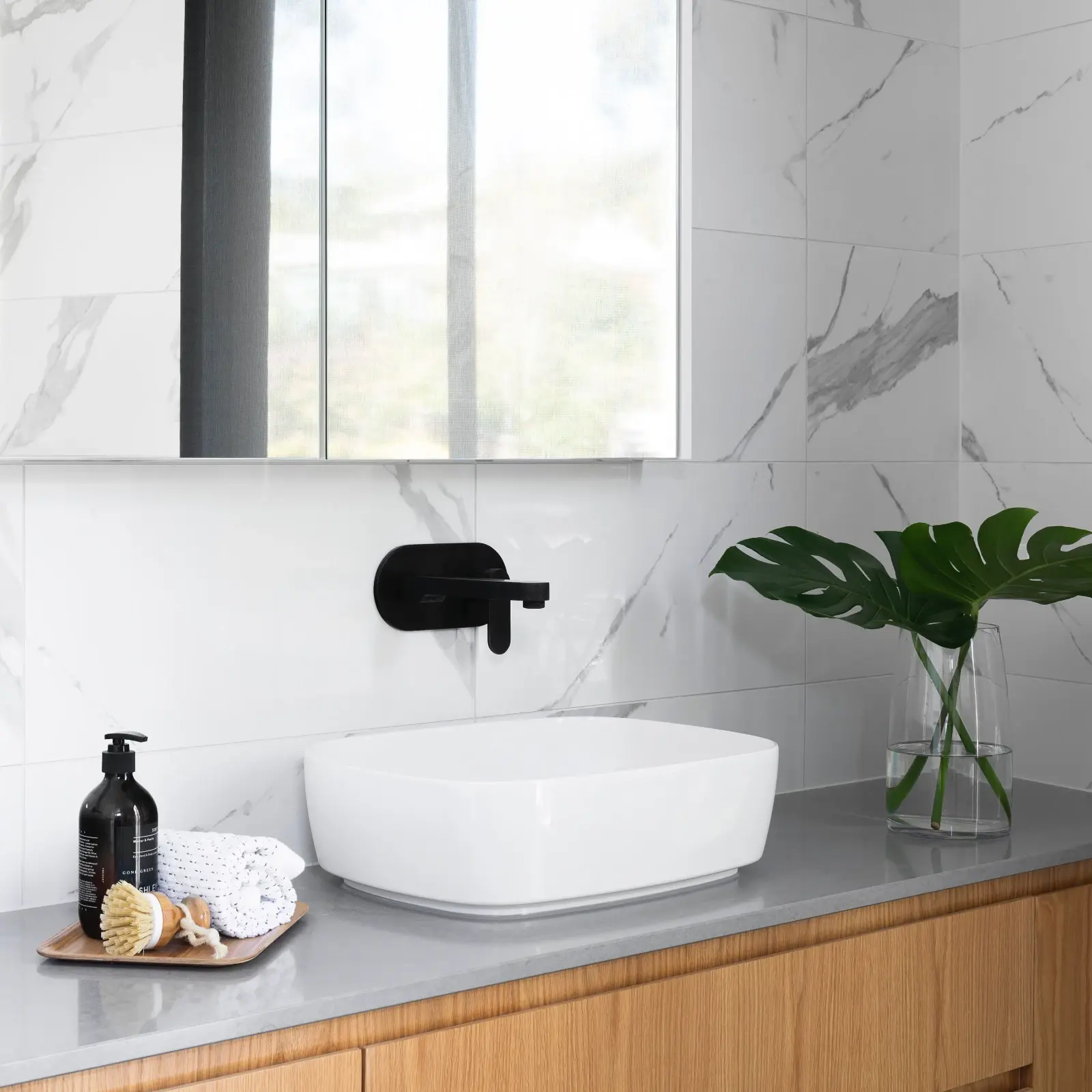
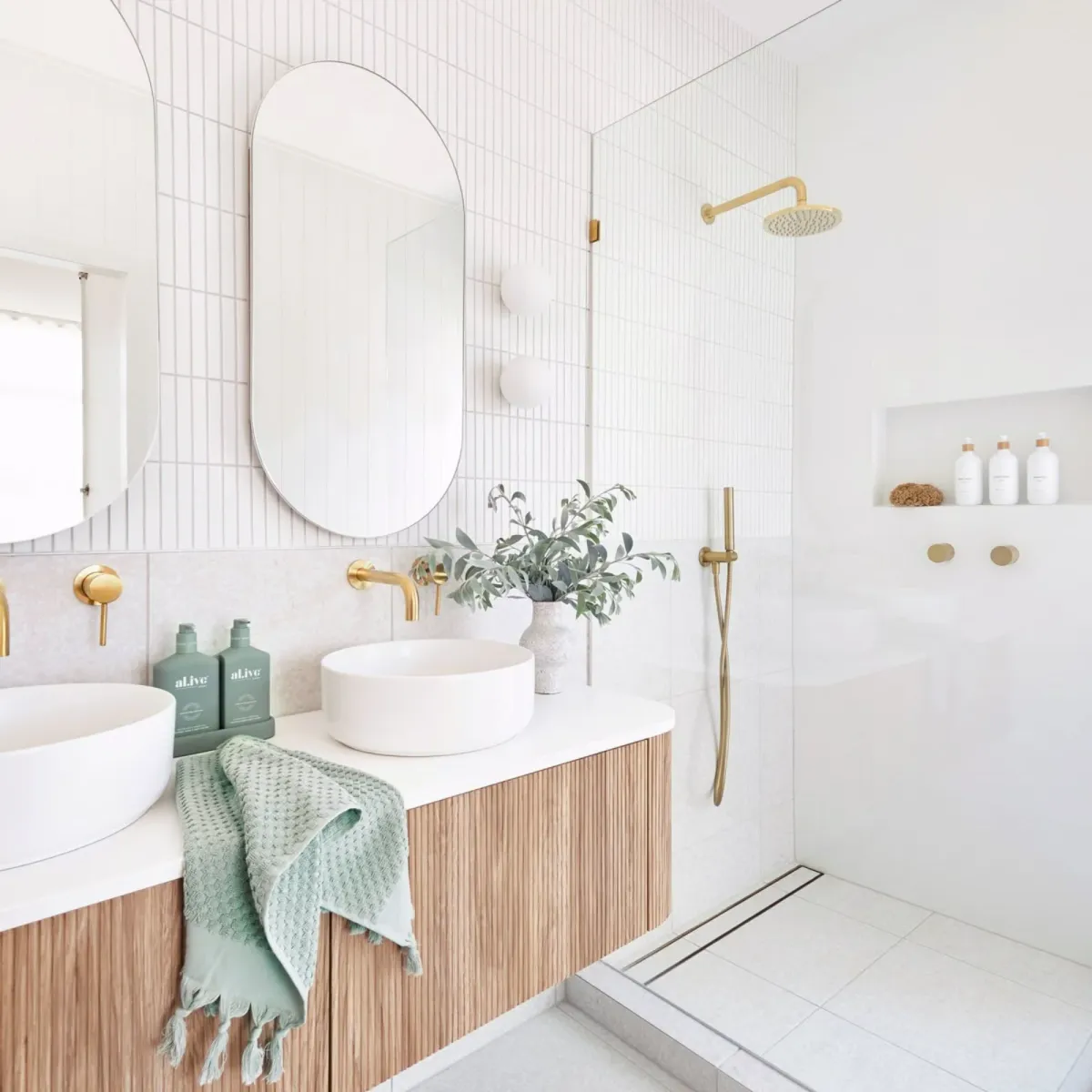
A wall-hung (floating) vanity exposes the floor and makes a small bathroom read as larger. The visual break between the vanity and the floor is a simple trick with a noticeable effect.
More practically, floating vanities are easier to clean around. A 600mm wide floating vanity with two drawers provides reasonable storage without dominating the room. Pair it with a mirror cabinet above instead of a flat mirror and you’ve added hidden storage without using any extra wall area.
If your plumbing is in the floor (common in older homes), a floor-mounted vanity is still fine. The key is keeping it proportionate. A 750mm vanity in a 2m wide bathroom will look crowded. A 600mm vanity won’t.
Large-format tiles, not small ones
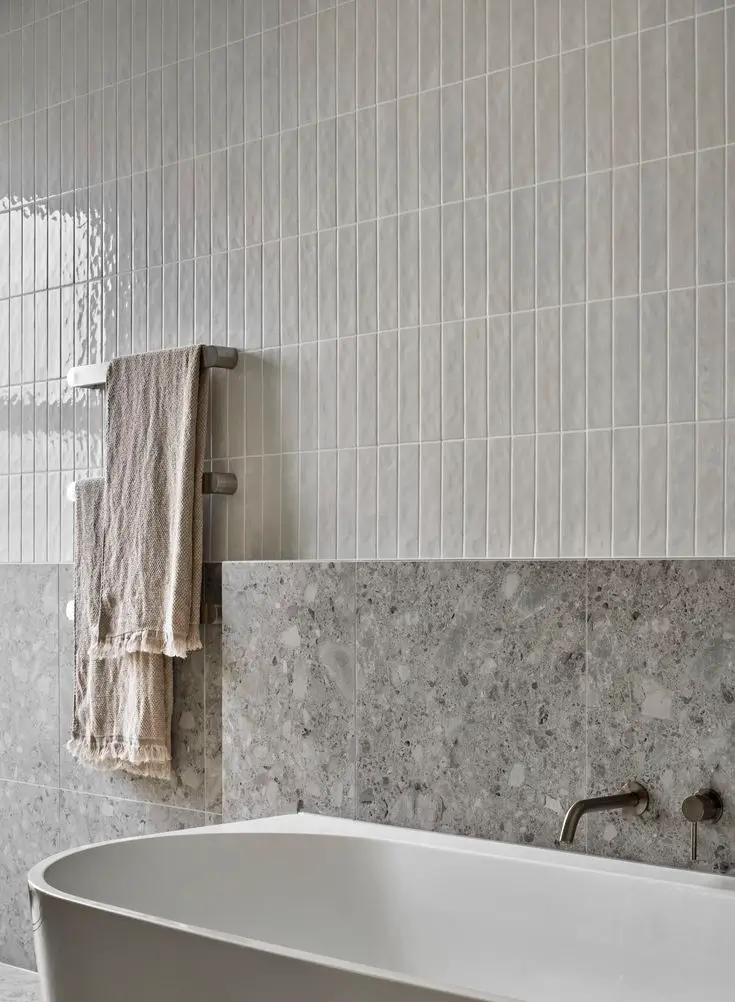
The common assumption is that small tiles suit small rooms. It’s the opposite. Small mosaic tiles or subway tiles with lots of grout lines visually chop up the space. Large-format tiles, typically 600mm x 600mm or 600mm x 1200mm, have fewer grout lines and make walls and floors read as a continuous surface.
Light neutrals work best: soft whites, pale stone tones, warm greys. You don’t have to go all-white. A warm travertine-look tile in a matte finish gives a similar spatial effect to white while avoiding the clinical feel.
Continuing the same tile from the bathroom floor into the shower floor, without a threshold or edge trim, extends the visual run of the floor and adds perceived length to the room.
Lighting in tight spaces
Bad lighting makes a small bathroom feel like a cupboard. Good lighting makes it feel calm and purposeful.
The combination that works: LED downlights on the ceiling (typically 90mm diameter, 3000K warm white) plus dedicated vanity lighting at face height. The overhead light alone leaves shadows across the face at the mirror, which most people find frustrating. A wall-mounted vanity light at around 1,800mm height from the floor fixes this.
If you’re working with a tight ceiling and can’t recess lights easily, surface-mounted IP65-rated lights are a clean option. The IP65 rating matters in bathrooms: it’s the minimum for lights installed within Zone 2 (outside the shower area), as required under Australian Standard AS/NZS 3000. Don’t let a sparky skip this.
Natural light is worth chasing if the opportunity exists. A skylight in a top-floor bathroom or a highlight window above tile height can significantly change how the room feels day-to-day. It’s not always structurally possible, but it’s worth asking the question.
Storage solutions that don’t eat floor space
Small bathroom storage is almost always a problem. The solution is building storage into the walls rather than adding it on top of them.
A recessed shower niche (typically 300mm wide x 200mm high x 100mm deep) is tiled in-place between studs. It gives you shelf space for shampoo, soap, and conditioner without any protrusion into the shower. A builder tiles it as part of the waterproofed shower area. It costs around $300–$600 to build and is a better long-term solution than any freestanding shower caddy.
A mirror cabinet replaces a flat mirror above the vanity and provides a full-depth storage cabinet behind it. Brands like Kado and Decor Assist make recessed and surface-mounted versions in a range of sizes. The recessed version, set into the wall stud cavity, sits flush with the wall and looks cleaner.
Towel storage is often forgotten in the planning stage. A heated towel rail on the wall opposite the shower is functional and warm. If floor space is very tight, a vertical rail or a rail mounted on the back of the door is a practical backup.
Small Bathroom Renovation: Cost and Timeline
This is where most guides go vague. We’ll be specific.
What a small bathroom renovation costs in Sydney
The table below reflects typical Sydney costs for a full bathroom renovation (strip-out to completion). These are 2026 figures for quality finishes, not the bottom of the market.
| Scope | Small bathroom (4–6m²) | Ensuite (3–5m²) |
|---|---|---|
| Entry-level (functional refresh) | $22,000–$26,000 | $18,000–$22,000 |
| Mid-range (good quality, no layout changes) | $26,000–$31,000 | $22,000–$26,000 |
| Premium (full layout reconfigure, quality fixtures) | $31,000–$42,000+ | $26,000–$35,000+ |
What’s included in these ranges: strip-out and disposal, waterproofing, plumbing and electrical, tiling, vanity, toilet, shower screen, tapware, mirror, and painting. What’s not included: any structural work, asbestos removal, or unusually difficult access.
Key cost drivers:
- Plumbing location: Moving drains is expensive. A toilet or shower drain relocated to a new position might add $2,000–$5,000. If you can keep plumbing where it is, do.
- Tile selection: Porcelain tiles at $40–$80/m² installed versus imported stone at $150–$350/m² installed is a significant difference across 20–30m² of coverage.
- Fixture grade: A Caroma or Kohler toilet suite at $400–$800 versus a Villeroy & Boch at $2,000+ makes a real difference to the budget without affecting function.
- Structural surprises: See the section below.
How long does a small bathroom renovation take?
On-site construction typically runs 3 to 4 weeks for a standard small bathroom renovation with no structural changes. Add 1 to 2 weeks if there’s layout reconfiguration or structural work involved.
That 3–4 week figure is from demolition to handover: strip-out, rough-in plumbing and electrical, waterproofing and curing time, tiling, fit-off, and final clean. The waterproofing cure is non-negotiable. AS 3740 requires membrane systems to fully cure before tiling, which typically means 24–48 hours between coats and before tiling begins. Rushing this step causes failures.
Lead time for planning, fixture ordering, and scheduling adds to the total. For a realistic week-by-week picture, our bathroom renovation timeline guide walks through each phase.
The hidden costs most people miss
A bathroom renovation quote is only as reliable as the information behind it. Here are the costs that commonly appear after strip-out, particularly in Sydney’s older housing stock.
Rotted substrate. Wet area leaks, often from previous waterproofing failures, rot the timber framing and floor sheeting behind tiles. You won’t see it until the tiles come off. In a pre-1980 home in Mosman or Cremorne, it’s not unusual to find one or two studs that need replacing and floor sheeting that has to come out. Budget $500–$2,000 for this as a contingency if your home is older.
Asbestos. Asbestos cement sheet (fibro) was used extensively in Sydney bathroom walls and floors until the mid-1980s. If your home was built before 1987, assume asbestos is present until a licenced asbestos assessor says otherwise. Licensed removal and disposal adds $1,500–$4,000 for a standard bathroom. This is a legal requirement under NSW Work Health and Safety regulations, not optional.
Ventilation upgrades. Old extract fans are frequently underpowered for current building standards. Replacing a fan and ducting it properly to an external exit (not just into the ceiling cavity, which is a common and problematic installation) typically costs $400–$800.
Waterproofing uplift. Some building inspectors require compliant waterproofing to extend beyond minimum code areas. If your existing sub-floor is uneven, a self-levelling screed may also be needed before tiling. Factor in $300–$700 if you’re unsure of the existing state.
A good builder will identify these risks during a pre-construction inspection, not surprise you with them halfway through. At LikeSilk, we build a contingency conversation into our pre-project planning rather than leaving it to the strip-out stage. Our process page explains how we handle scope changes if they do come up.
Fixed price vs cost-plus for small bathrooms
Most small bathroom renovations work well on a fixed-price contract, provided the scope is clearly defined and pre-construction inspections have been done. Fixed price gives you budget certainty.
Cost-plus (where you pay actual costs plus a builder’s margin) is worth considering if your home is older and there are genuine unknowns about the existing structure. You pay less if the work is straightforward and more if it isn’t, rather than the builder pricing a risk premium into a fixed price to protect themselves.
The key in both cases is transparency. Your contract should spell out what is included in the base price, how variations are priced, and what the approval process is if the scope changes. See our post on fixed price vs cost-plus contracts for a fuller breakdown of how each works.
Common Small Bathroom Mistakes
These come up repeatedly on North Shore renovation projects. Most are avoidable with better planning.
Undersizing the vanity or getting the height wrong. Standard vanity height in Australia is 850mm, which suits most people. If you’re tall, 900mm is more comfortable. Getting this wrong means years of leaning down every morning. It’s a five-minute conversation to get right at the planning stage.
Wrong tile choices for moisture. Polished tiles are slippery when wet. Matte porcelain is a safer floor choice in wet areas. Grout that isn’t sealed will absorb water and discolour within months. Epoxy grout in the shower is more expensive but far more durable than cement-based grout. Your builder should be advising on this, not leaving it as a detail for you to discover later.
Poor ventilation. An undersized or improperly ducted extract fan leads to condensation, mould, and eventual tile and grout failure. The fan should be rated for the volume of the room (measured in litres per second) and ducted to the exterior, not just vented into the roof cavity. A licenced electrician should install it. This isn’t a place to cut costs.
No plan for accessibility. You probably don’t need accessibility features now. But future-proofing a small bathroom isn’t difficult or expensive at the time of renovation, and retrofitting it later is very expensive. Consider a hobless shower, wider doorway if structurally possible, and blocking the wall for future grab rails when tiling. None of these cost much if they’re planned from the start.
Ignoring water pressure. Low water pressure makes a shower frustrating regardless of how good it looks. If your home has a gravity-fed system or ageing pipes, check pressure before specifying tapware. A pressure-boosting pump can be added for around $800–$1,500 but needs to be planned before fit-off, not added as an afterthought.
Cutting corners on waterproofing. Waterproofing failure is the most expensive bathroom problem to fix. It requires a complete strip-out and redo. The National Construction Code requires licensed waterproofers to apply membrane in wet areas under AS 3740. In NSW, waterproofing must be inspected and certified. Make sure your builder includes this and can show you the certificate.
The Role of Professional Planning in Small Spaces
Small bathrooms are where professional input pays off most clearly. There are fewer square metres to hide mistakes, and the decisions made early, particularly around layout and plumbing locations, are expensive to undo.
A good builder or designer who has worked on dozens of small Sydney bathrooms has seen what works in the local housing stock. They know that a pre-war terrace in Cremorne has different structural constraints to a 1970s brick veneer in Lane Cove. They have relationships with tile suppliers and can show you products at trade pricing you won’t see in a showroom.
3D visualisation before committing to a layout is worth asking for. Seeing a to-scale model of your bathroom with actual fixture dimensions in place prevents a lot of the “I didn’t realise how small that would look” moments that come from selecting products in a showroom without a site context.
DIY vs hiring a professional for small bathrooms
Some work is genuinely suitable for a capable DIYer. Painting, replacing tapware on existing connections, swapping a toilet seat, installing a towel rail. These are low-risk, no-permit tasks.
The following work in NSW requires a licensed tradesperson and in most cases a permit or inspection:
- Any plumbing work (drainage changes, pipe relocation, fixture connection)
- Any electrical work (new lights, extract fan installation, heated towel rail wiring)
- Waterproofing (licensed waterproofer required, certificate of compliance issued)
- Structural changes to walls or floor
Attempting these yourself isn’t just a compliance issue. It affects your home insurance. If a DIY plumbing failure causes water damage, an insurer may decline the claim if unlicensed work is found to be the cause. It’s not worth the risk on a $20,000+ renovation.
For a fuller comparison of what you can DIY versus what to leave to a pro, our DIY vs professional bathroom renovation guide covers this in detail.
Professional planning through a builder like LikeSilk means the end-to-end process is managed: design, approvals, subcontractor coordination, inspections, and handover. You don’t have to coordinate a plumber, a waterproofer, a tiler, and an electrician separately. That coordination is the product, not just the tiles. If you want to understand what working with us looks like, our Renovation Blueprint guide is a good starting point.
Typical Small Bathroom Layouts for Sydney Homes
Layout options vary with room dimensions. These are the most practical configurations we work with.
Straight layout (2.4m x 1.5m): Toilet and vanity on the long wall, shower in the corner. Works in small ensuites. Sliding pocket door is better than a hinged door at this size.
L-shaped layout (2.4m x 2m): Shower across one short end, vanity and toilet on the adjacent wall. Gives the shower a full 900mm width and keeps the vanity accessible without crowding.
Wet room (2m x 2m square): Shower over the floor drain with no screen or step, just a gentle floor fall to the drain. Works well where dimensions are square and you want maximum visual openness. The whole floor is waterproofed, not just the shower area.
Regardless of layout, minimum clearances under the National Construction Code include 600mm in front of a toilet, 600mm clear access to a shower entry, and 750mm at the side of a vanity where a door opens. Your builder should be checking these at the planning stage, not after tiling.
If you’re unsure how these configurations would work in your space, our bathroom renovation checklist includes a pre-planning section to help you work through the options before you talk to a builder.
What North Shore Small Bathrooms Actually Cost: A Few Real Ranges
We don’t publish case studies with specific client details, but we can share representative scope and cost ranges from the kinds of projects we work on across Mosman, Lane Cove, Willoughby, and surrounding suburbs.
Ensuite refresh, no layout changes: 4m² ensuite in a 1990s North Shore home. Existing plumbing retained. New frameless shower screen, floating vanity, wall-hung toilet, large-format tile, new lighting. Approximate cost: $18,000–$22,000. Timeline: 3 weeks.
Full small bathroom reconfigure: 5m² bathroom in a 1960s Lane Cove brick home. Bath removed, walk-in shower added, plumbing partially reconfigured, asbestos removed from walls, full re-tile, new vanity and toilet. Approximate cost: $28,000–$34,000. Timeline: 4–5 weeks.
Heritage home bathroom update: 4.5m² bathroom in a pre-war Mosman terrace. No layout changes but full strip-out, structural repairs to subfloor, period-appropriate tile selection, new fixtures. Approximate cost: $25,000–$32,000 depending on tile selection and structural findings. Timeline: 4 weeks plus.
These ranges include all labour, materials, waterproofing, tiling, and fit-out. They don’t include furniture, soft furnishings, or artwork.
Your Next Steps
If you’re at the early stages of thinking about a small bathroom renovation, here’s a practical sequence.
First, get a clear picture of what you want the room to do. Storage needs, who uses it, any accessibility considerations, and your honest budget. Writing this down as a brief before you talk to a builder saves time for everyone.
Second, get a realistic sense of cost before you start choosing tiles. Our bathroom renovation cost guide gives you Sydney-specific benchmarks.
Third, understand the timeline. Our bathroom renovation timeline guide explains what happens each week from planning to handover.
When you’re ready to talk to a builder, our bathroom renovation checklist is a useful tool for preparing the right questions.
Book a 20-minute consultation with LikeSilk Building. We’re a family-run licensed builder on Sydney’s North Shore (licence 274849C). We cover the full renovation journey: design input, fixed and cost-plus contracts, subcontractor management, and handover. No project managers passed between you and the people doing the work.
Frequently Asked Questions
How much does a small bathroom renovation cost in Sydney?
A full small bathroom renovation (4–6m²) in Sydney typically costs $26,000–$31,000 for mid-range finishes with no structural changes. Premium finishes, layout reconfigurations, or structural repairs will push the cost higher, often to $31,000–$42,000+. Ensuites of a similar size tend to run slightly less due to their smaller footprint. For a detailed breakdown, see our bathroom renovation cost guide.
How long does a small bathroom renovation take?
On-site construction takes 3 to 4 weeks for a straightforward small bathroom renovation. Add 1 to 2 weeks for any layout changes or structural work. The total project time including planning, design, material ordering, and approvals is typically 6 to 10 weeks from initial consultation to on-site start. Our weekly timeline guide walks through each stage.
What’s the best tile choice for a small bathroom?
Large-format porcelain tiles in light neutral tones work best for maximising the perceived size of a small bathroom. 600x600mm or 600x1200mm tiles have fewer grout lines, which keeps the visual field clean. Matte finish is safer on floors than polished. Continuing the same floor tile into the shower without a threshold extends the visual run of the floor and makes the room feel longer.
How do I make a small bathroom look bigger?
The most effective approaches: frameless glass shower screen instead of a framed one or a shower curtain; floating (wall-hung) vanity to expose more floor; large-format light tiles; mirror cabinet rather than a flat mirror; and good layered lighting with both overhead LED downlights and face-height vanity lighting. None of these are tricks. They’re practical decisions that happen to have a spatial effect.
Can I renovate a small bathroom myself?
Minor work, such as painting, replacing tapware, or swapping hardware, is fine to DIY. Plumbing, electrical, waterproofing, and structural work all require licensed trades in NSW. Attempting these unlicensed risks your home insurance and your builder’s warranty. For a clear breakdown of what you can and can’t DIY, see our DIY vs professional bathroom renovation guide.
What fixtures work best in small bathrooms?
Wall-hung fixtures (vanity, toilet) visually free up floor space. Compact wall-hung toilets (cistern concealed in wall) are around 300mm deep compared to 650–700mm for a close-coupled suite. A 600mm wide floating vanity gives functional storage without crowding the room. In the shower, wall-mounted tapware rather than floor-mounted is cleaner and takes up no floor area. Our bathroom fixtures and tapware guide covers product options in more detail.
Should I choose a walk-in shower or bath for a small space?
If the bathroom is your only bathroom, keep the bath unless you’re certain you won’t need it for the foreseeable future. If it’s an ensuite or second bathroom, a walk-in shower is almost always the better use of the space. A standard bath takes 1.1m² of floor space and requires clearance around it. A 900x900mm corner shower uses less space and is easier to use daily. The honest trade-off is resale: buyers with young children generally expect a bath in at least one bathroom.
How important is lighting in a small bathroom?
Very. A single overhead downlight in a small bathroom leaves the face in shadow at the mirror and makes the room feel dim. Vanity lighting at face height (around 1,800mm from the floor) is a functional improvement that also changes how the room feels. LED warm white (3000K) rather than cool white (5000K) makes a significant difference to the atmosphere. Good lighting is one of the cheaper ways to improve a small bathroom and one of the most overlooked.
What’s the difference between an ensuite and a main bathroom renovation?
Mostly scale and the expectation of a bath. A main bathroom is typically the shared family bathroom and usually includes a bath, separate shower, and double vanity if space allows. An ensuite is an attached private bathroom for a bedroom, usually smaller and more focused on a shower and vanity. The build process is the same but the fixture list differs. Ensuites tend to cost slightly less due to their smaller size, though fixture quality choices can bring them to the same price point as a main bathroom.
How do I avoid costly mistakes in a small bathroom renovation?
The most expensive mistakes come from poor planning, not poor execution. Layout changes that require plumbing relocation after construction has started cost two to three times more than planning them correctly upfront. Waterproofing failures that aren’t caught in inspection require a full strip-out to fix. The best protection is a builder who does thorough pre-construction inspections, discusses risks before breaking ground, and has a clear variation process in the contract. A signed home renovation checklist and a realistic contingency of 10–15% of the build cost are practical first steps.
Waterproofing in wet areas is regulated under AS 3740 and the National Construction Code, administered by the Australian Building Codes Board. Builder licensing in NSW is administered by NSW Fair Trading. Industry guidance on safe renovation practices, including asbestos management, is published by Safe Work Australia and the Housing Industry Association.