
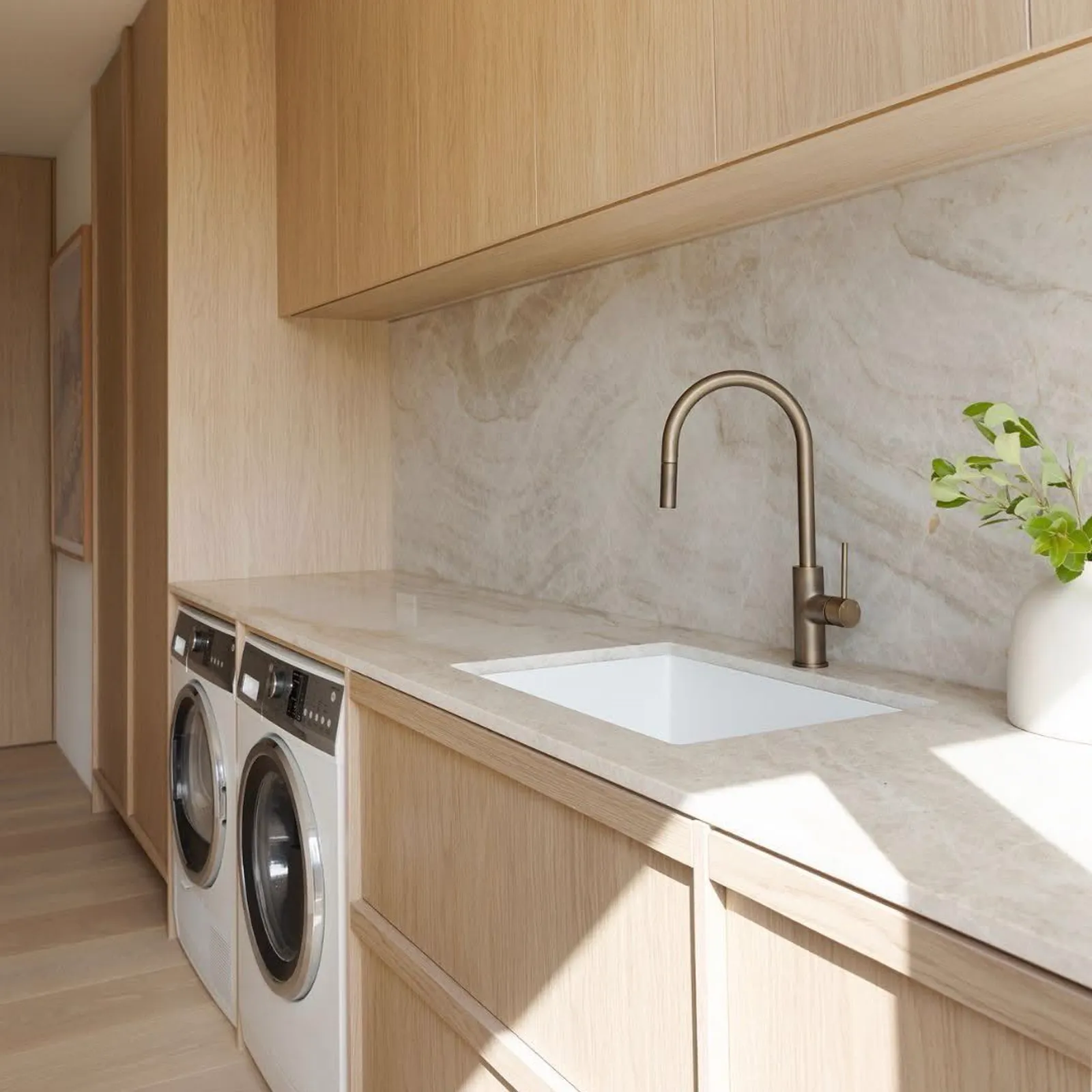
The laundry is one of the most used rooms in any home and one of the most overlooked in a renovation. Most Sydney homeowners spend years dealing with a cramped, poorly lit space with no bench, no storage, and a floor drain that makes the whole thing feel like a utility cupboard rather than a functional room.
A well-designed laundry changes your daily routine more than you’d expect. It also adds real resale value, particularly in the North Shore market where buyers expect a finished home.
Mid-range laundry renovations in Sydney cost between $15,000 and $35,000. Basic refreshes start from around $5,000. Fully designed European laundries with premium finishes sit from $35,000 to $60,000 and beyond. What you spend depends on the size of the space, how much plumbing and electrical work is involved, and the quality of your selections.
This guide covers everything: what a European laundry actually is, layout options for different home types, design ideas for finishes and storage, real cost breakdowns, a week-by-week timeline, and the mistakes we see most often.
If you want a quick sense of costs before reading further, our bathroom renovation calculator gives you a useful reference point for how renovations in Sydney are priced.
What Is a European Laundry?
The term gets thrown around a lot, so let’s be clear about what it actually means.
A European laundry is a purpose-designed laundry space integrated into the home, typically concealed within a built-in joinery unit or a small dedicated room. The idea is that the laundry functions beautifully but disappears visually, either behind closed doors or blending seamlessly with the surrounding space.
It is not a laundry cupboard jammed with an old top-loader. Done properly, a European laundry is a considered space with integrated appliances, a stone or engineered stone benchtop, good cabinetry, a trough or sink, quality lighting, and practical storage.
Why North Shore homes love them
The North Shore has a lot of homes that were built or renovated in the 1980s and 1990s. Many of them have a separate laundry off the garage or a narrow room alongside the bathroom. Neither works particularly well for modern family life.
European laundries solve two problems at once. They reclaim usable floor space by stacking appliances or integrating them under a bench, and they give you a room (or concealed space) that actually functions as a proper working area. If you’re renovating a terrace in Neutral Bay or a Federation home in Mosman, a European laundry can also fit into a space that would never support a traditional dedicated laundry.
What a European laundry includes
- Front-loading washer and dryer stacked or side-by-side under bench
- Integrated cabinetry with doors, often floor-to-ceiling
- Stone or engineered stone benchtop for folding
- Trough or utility sink (sometimes omitted in very tight spaces)
- Good overhead and task lighting
- Practical storage: pull-out hampers, overhead shelving, broom cupboard
Cost ranges for European laundries in Sydney
| Tier | Cost Range | What You Get |
|---|---|---|
| Basic | $5,000 – $15,000 | Flatpack or semi-custom cabinetry, laminate benchtop, standard taps and trough, basic tiling |
| Mid-range | $15,000 – $35,000 | Custom joinery, engineered stone benchtop, good appliances, full tiling, quality tapware |
| Premium | $35,000 – $60,000+ | Full custom cabinetry, premium stone, integrated appliances, designer lighting, concealed everything |
These are installed costs. They include labour, materials, and basic plumbing and electrical. Significant plumbing relocation or structural changes will add to these figures.
Laundry Layout Options
The right layout depends on your space, your home type, and how you actually use the room. Here are the three configurations we work with most often.
Dedicated European Laundry Layout
This is a small room (typically 4–8m² in a house) designed specifically for laundry functions. You have four walls to work with, which gives you real flexibility.
The most efficient layouts for a dedicated laundry run cabinetry along one wall with appliances stacked or side-by-side under the bench, a trough at one end, and overhead storage above. If you have the space, a second run of cabinetry opposite creates a U-shape or galley configuration, which is excellent for workflow.
North Shore houses commonly have laundries in the 6–10m² range. That is enough space to include a hanging rail for air-drying, a full-height linen or cleaning cupboard, and a generous folding bench. Apartments typically work with 2–4m².
The dedicated layout is the most functional option if you have the space. It keeps the mess and noise contained, gives you the most storage, and allows for a proper folding bench at a comfortable working height.
Combined Bathroom and Laundry Layouts
Combined bathroom and laundry spaces are common in Sydney apartments and in older homes where the original floor plan never allocated a separate laundry. Done well, they work. Done poorly, the laundry function compromises the bathroom, and vice versa.
The key is clear zoning. The wet zone (shower, bath, toilet) stays separate from the laundry zone. A floating vanity with a recessed appliance niche alongside it, or a floor-to-ceiling cabinetry wall on one side of the room with the appliances concealed behind doors, are both approaches that work well.
Waterproofing is non-negotiable in a combined space. Appliances emit humidity and heat. The floor and wall waterproofing membrane needs to meet the full requirements of AS 3740, not just what’s standard for a bathroom. A licensed plumber and tiler who understand the requirements will get this right. One who doesn’t will cost you far more down the track.
Our team works on bathroom and laundry renovations across the North Shore regularly. If you’re considering a combined layout, we can talk you through what’s involved before you commit to a design direction.
Small Laundry Renovations
A small laundry (under 4m²) in an apartment or compact home can absolutely be functional if the design is thoughtful. The difference between a tight laundry that works and one that frustrates you daily comes down to three things: appliance selection, joinery design, and lighting.
Stacked appliances are almost always the right choice in a small space. Side-by-side front-loaders take up twice the floor width with no gain in capacity. A stacked pair with a bench alongside or below gives you the same capacity with a much more usable layout.
Overhead storage is essential when floor space is limited. Full-height cabinetry beside or above the appliances, with a bench pulled to a comfortable working height (850–900mm is standard), makes a 3m² laundry genuinely workable.
One thing we hear from clients after the renovation: “I can’t believe how much better that feels.” A small laundry with good lighting, decent cabinetry, and a proper bench is a completely different experience from the same space with open shelving and a bare bulb overhead.
For apartments undergoing a full interior renovation, the laundry is almost always included in scope, because the trades are already there and the uplift is significant relative to cost.
Design Ideas: Finishes, Storage and Workflow
Finishes
The finishes you choose set the tone for the whole space. The good news is that a laundry does not need expensive materials to look and feel premium. The details matter more than the price tag.
Benchtops: Engineered stone (Silestone, Caesarstone, Quantum Quartz) gives you a hardwearing, easy-clean surface that looks sharp. You don’t need marble. You don’t need the most expensive slab in the range. A mid-tier engineered stone in a neutral colour (white, light grey, warm off-white) will look excellent and hold up to daily use. Budget $600–$1,200 for a standard laundry bench in engineered stone, installed.
Cabinetry: This is where we’d spend money if we had to choose. Quality cabinetry with soft-close hinges, properly designed internals, and moisture-resistant board makes a laundry feel considered. Polyurethane or two-pack paint finishes are more durable than printed foil in a wet environment. White, off-white, and sage green are the most popular choices on the North Shore right now.
Splashback: Subway tile is classic and easy to clean. Large-format tile with minimal grout lines looks sleeker and is easier to maintain. A full-height tiled splashback from bench to overhead cabinet is the cleanest look.
Flooring: Porcelain tile is the most practical choice. It handles water, cleaning product spills, and heavy foot traffic. Matte finishes are less slippery when wet. If you’re tiling adjacent areas, running the same tile through the laundry (and into a combined bathroom) creates a cohesive look.
Lighting: The laundry is almost always underlit. Overhead downlights plus under-cabinet LED strips make a real difference. You’re sorting colours and checking stains in this room. Good lighting is not a luxury.
Storage Solutions
Storage design makes or breaks a laundry. The things that need to live in this room: detergent, fabric softener, stain removers, cleaning products, ironing board, iron, brooms, mops, vacuum cleaner, linen, and your washing. That is a lot of items for a small space.
The storage solutions that work best:
- Pull-out hamper drawers: One for lights, one for darks. Keeps dirty washing contained and sorted without taking up floor space.
- Tall broom cupboard: A 300mm-wide floor-to-ceiling cabinet handles the ironing board, broom, mop, and vacuum with the door closed. Non-negotiable in our opinion.
- Overhead cabinets: Accessible above the bench and above the appliances for folded linen, spare supplies, and items used less frequently.
- Pull-out bins: A recessed bin pull-out in the cabinetry for lint traps and small rubbish keeps the bench clear.
- Open shelf section: One section of open shelving for frequently used items (detergent, stain remover) beats opening and closing a door twenty times a day.
Workflow Design
A laundry that works with your routine rather than against it follows a simple path: dirty clothes in, washed, dried, folded, put away. The design should reflect that path.
The hamper zone (where dirty washing lands) should be closest to the door. The appliances in the middle. The folding bench beside or above the appliances so you can pull things straight out of the dryer onto the bench. Linen storage accessible from the folding bench. The ironing board directly below or beside the pressing area.
It sounds obvious, but most laundries are designed without any thought for this sequence. The appliances end up at the far end, the folding space is across the room, and the whole thing adds unnecessary steps to a task that already happens multiple times a week.
Laundry Renovation Costs in Sydney
Sydney pricing is what it is. Labour costs are high, trades are in demand, and quality materials have not got cheaper. Here is an honest breakdown of what you’re actually paying for.
Cost by tier
| Tier | Total Cost | Joinery | Stone Bench | Tiling | Plumbing | Electrical |
|---|---|---|---|---|---|---|
| Basic | $5K – $15K | Flatpack / semi-custom | Laminate or budget stone | Partial or full | Basic reposition | Lighting + GPO |
| Mid-range | $15K – $35K | Custom or semi-custom | Engineered stone | Full floor and walls | Plumber + tapware | Downlights + exhaust |
| Premium | $35K – $60K+ | Full custom cabinetry | Premium stone or marble | Large-format tile | Full plumbing scope | Designer lighting |
What’s included in each tier
Basic ($5K–$15K): A functional improvement. New cabinetry (often flatpack or semi-custom), a fresh benchtop, new tapware, and a tiled splashback or floor. Typically suited to a small laundry that just needs a refresh, not a full redesign. Appliances not included.
Mid-range ($15K–$35K): This is where most North Shore renovations sit. Custom or semi-custom cabinetry, engineered stone benchtop, full wall and floor tiling, new trough and tapware, exhaust fan, quality lighting, and a properly designed layout. Appliances not included.
Premium ($35K–$60K+): Full custom joinery, premium stone, large-format tiles, concealed appliances, designer tapware and lighting, and often a complete reconfiguration of the space. This tier is for homeowners who want the laundry to feel like an extension of the kitchen, not a utility room.
Hidden costs to know about
These are the items that often get missed in initial estimates and add to the final cost.
Plumbing relocation: If the washer connection or trough needs to move to a new position, expect $1,000–$3,000 depending on the complexity. Moving across the room costs more than moving a few hundred millimetres. If your plumber has to go through a slab, costs increase significantly.
Electrical: New GPOs (power points), a dedicated circuit for the dryer, and downlights typically add $800–$1,500. If you’re adding a heated towel rail or upgrading your switchboard, add more.
Ventilation: A proper exhaust fan ducted to the outside (not just recirculating) runs $500–$1,200 installed. Moisture management in a laundry is genuinely important. Skimping on this causes mould.
Waterproofing: If your laundry is being tiled and the existing waterproofing is inadequate or missing, the cost to strip and re-waterproof adds $800–$1,500 to the job. Worth every cent.
Asbestos removal: Many pre-1990 homes on the North Shore have asbestos-containing material in laundry flooring or wall sheeting. Testing costs around $150–$300. Removal (if required) is quoted separately by a licensed removalist and varies significantly by volume.
For context on how laundry renovation costs compare to other interior projects, see our guides on kitchen renovation costs in Sydney and bathroom renovation costs in Sydney.
Timeline: Week by Week
A laundry renovation of typical scope (mid-range, no structural changes) takes 5–7 weeks from start to finish. Here is what that looks like in practice.
Weeks 1–2: Planning and preparation
Before any physical work begins, the design needs to be locked. That means final cabinetry drawings approved, stone benchtop template scheduled, tiles selected and on order, appliances confirmed, tapware and fixtures ordered.
This stage often takes longer than people expect because some items have lead times. European appliances can have 4–8 week delivery windows. Custom stone benchtops are templated after cabinetry is installed, not before. Ordering tiles early avoids delays mid-project.
We also use this period to get trade quotes confirmed, permits confirmed (if required), and a clear construction programme to the client before any tools come out.
Weeks 3–4: Demolition, plumbing and electrical
Demolition of the existing laundry typically takes half a day to a full day for a standard room. Plumbing rough-in happens next: waste, water supply, and any relocations. Electrical rough-in follows: new circuits, GPO positions, lighting layout.
Both plumbing and electrical need to be inspected before walls close up. This is not optional. A licensed plumber and licensed electrician must sign off on their work, and the certifier or council inspector (depending on your approvals pathway) inspects before lining.
Weeks 4–5: Walls, flooring and tiling
Wall sheeting (if required), waterproofing membrane, and tiling. Tiling takes longer than most homeowners expect. For a full wall and floor tile installation in a laundry, allow 2–4 days for a skilled tiler depending on tile size and layout. Grout curing time adds another day or two before the space can be used.
Weeks 5–6: Cabinetry, benchtop and appliances
Cabinetry installation once tiling is complete and surfaces are clean. The stone benchtop is templated after cabinetry is in place and fabricated over 1–2 weeks, so timing needs to be built into the programme from the start.
Appliances are installed once the bench and connections are in place. Tapware and trough fitted by the plumber. Final electrical connections made.
Weeks 6–7: Final details and handover
Painting touch-ups, installation of lighting, exhaust fan, accessories (hooks, toilet roll holders, towel rails if included). Final plumbing and electrical sign-off. Defect inspection walk-through with the client. Handover documentation including warranties, manuals, and care instructions.
For a detailed look at how we manage the full build process, visit our renovating with us page.
Common Mistakes to Avoid
We see these regularly. Not as warnings, just as the things worth knowing before you start.
1. Choosing appliances after the joinery is designed
The joinery needs to be designed around the appliances, not the other way around. Front-loader dimensions vary by brand. The cavity depth, height, and width need to be locked before your cabinetmaker draws a single line. Get your appliance specs first.
2. Skimping on ventilation
A laundry generates significant moisture. A dryer without external ducting pushes humidity into the room. A space without an exhaust fan connected to outside becomes a mould factory within 12–18 months. We see this constantly in older laundries on the North Shore. Budget for a properly ducted exhaust fan from day one.
3. Using flatpack MDF cabinetry in a wet environment
Flatpack MDF warps within 2–3 years in a laundry. We see it constantly. The humidity, the occasional splash, the steam from drying cycles, all of it slowly destroys standard MDF board. If your laundry is going to last, use moisture-resistant board (HMR or similar) at minimum. In a premium job, consider a polyurethane or two-pack painted finish on a moisture-resistant substrate.
4. Leaving out the sink or trough
A laundry without a trough feels incomplete and makes hand-washing, soaking, and wet tasks awkward. It’s tempting to leave it out to save space or budget, but the day you need to soak something and have nowhere to do it, you’ll wish you hadn’t. A compact 32L trough fits in tighter spaces than most people expect.
5. No dedicated folding space
Folding washing on the dining table, the couch, or the bed is one of those small annoyances that happens multiple times a week. A bench at the right working height (850mm) with space to lay a full sheet flat transforms this task. Design it in from the start.
6. Ignoring the ceiling height
Most laundries have 2,400mm ceilings. Custom cabinetry can go floor-to-ceiling, using the full height for storage and eliminating the awkward gap at the top that collects dust. It also makes the room feel taller and more finished. It costs marginally more. Worth it.
7. Not planning for the ironing board
An ironing board that lives behind a door in a dedicated cabinet is genuinely life-changing. An ironing board that leans against the laundry wall or lives in a bedroom cupboard is a minor daily inconvenience. A 300mm-wide floor-to-ceiling cabinet handles the ironing board and everything else without taking meaningful floor space.
Is a Laundry Renovation Worth It?
The honest answer: yes, more than most homeowners expect.
Resale value
The renovation returns data for Australian properties consistently shows laundry renovations returning 5–8% ROI relative to the renovation cost when the property is sold. On a $25,000 renovation, that’s $1,250–$2,000 in added sale value for every $1 spent. The return is highest when the laundry is genuinely poor relative to the rest of the home, and lower when the home already presents well.
In the North Shore market specifically, buyers have high expectations. A poorly finished laundry in a beautifully renovated home is a visible gap. Agents consistently tell us it affects buyer perception and, in some cases, negotiation.
Daily quality of life
This one is harder to put a number on but easier to feel. A laundry that works properly reduces one of those low-grade daily stresses that adds up over time. You’re in this room multiple times a week, every week. The difference between a frustrating space and a functional one is a real quality-of-life improvement.
That said, a laundry renovation is not about a prestige outcome the way a kitchen or master bathroom is. You’re not going to impress dinner guests with it. The value here is in practical function, daily ease, and a finished home that presents coherently from front to back.
What actually adds resale value vs what doesn’t
What adds value: proper layout, quality cabinetry, stone benchtop, full tiling, good lighting, a trough, ventilation, and an integrated look that matches the home.
What adds cost without proportional return: luxury appliances (mid-range is fine for resale), premium stone (engineered stone performs just as well), or bespoke joinery details that a buyer won’t distinguish from quality custom.
The sweet spot for resale is the mid-range tier. Functional, finished, and clearly considered. Buyers notice the difference between that and flatpack. They don’t notice the difference between mid and premium stone.
Ready to Start Your Laundry Renovation?
A well-designed laundry is one of those renovations that genuinely surprises people. Not because it’s flashy, but because it works so much better than what was there before.
At LikeSilk Building, we’re a licensed builder (274849C) based on Sydney’s North Shore. We handle interior renovations across Mosman, Cremorne, Neutral Bay, Northbridge, Lane Cove, and surrounding suburbs. We manage the full scope: design, cabinetry, tiling, plumbing, electrical, and handover.
If you’re thinking about a laundry renovation and want to understand what’s involved for your specific home, a planning call is the best place to start. No pressure, no sales pitch. Just a straightforward conversation about your space, your goals, and what’s realistic.
Book a free renovation planning call to talk through your project.
Or if you’d prefer to start with a written enquiry, contact us and we’ll come back to you within one business day.
Frequently Asked Questions
What is a European laundry?
A European laundry is a purpose-designed laundry space, typically integrated into built-in cabinetry or a small dedicated room, that conceals the appliances and laundry function behind closed doors. It differs from a traditional laundry in that it prioritises a clean, designed aesthetic alongside practical function. Key features include integrated appliances, a stone or engineered stone benchtop, quality cabinetry, and proper lighting.
How much does a laundry renovation cost in Australia?
Laundry renovations in Australia typically range from $5,000 for a basic refresh to $60,000 or more for a premium European laundry with full custom cabinetry. Mid-range renovations, which represent the most common scope, sit between $15,000 and $35,000. Costs vary depending on the size of the space, materials selected, and how much plumbing and electrical work is required.
How much does a laundry renovation cost in Sydney?
Sydney pricing runs slightly above national averages due to higher trade labour costs. A basic laundry renovation starts from around $7,000–$15,000 in Sydney. Mid-range sits at $15,000–$35,000. Premium European laundries with full custom joinery and stone benchtops start from $35,000 and can reach $60,000 or more. Hidden costs like plumbing relocation ($1,000–$3,000) and ventilation upgrades ($500–$1,200) should be factored in from the start.
Is a laundry renovation worth it?
Yes, for most Sydney homeowners. A well-designed laundry returns 5–8% ROI on the renovation investment at resale, and the daily quality-of-life improvement is real given how frequently the space is used. In the North Shore market, buyers expect a finished home throughout, and a poorly presented laundry in an otherwise renovated property is a visible gap. The mid-range tier delivers the best value for most people.
How long does a laundry renovation take?
A mid-range laundry renovation in Sydney typically takes 5–7 weeks from start to finish. This includes 1–2 weeks of planning and ordering, 1–2 weeks for demolition, plumbing, and electrical, 1–2 weeks for tiling, and 1–2 weeks for cabinetry, bench installation, and finishing. Complex projects involving structural changes or significant plumbing relocation may take longer.
What should be included in a laundry renovation?
A well-designed laundry renovation should include: quality cabinetry with moisture-resistant board, a stone or engineered stone benchtop at comfortable working height, a trough or utility sink, full floor and wall tiling with appropriate waterproofing, a properly ducted exhaust fan, good overhead and task lighting, dedicated GPOs and electrical circuits, and practical storage including space for an ironing board and cleaning equipment.
Can I renovate a small laundry?
Yes. A laundry of 2–4m² can be made genuinely functional with the right design. Stacked appliances (rather than side-by-side) recover significant floor width. Full-height cabinetry uses vertical space efficiently. A compact trough (32L) fits in tighter spaces than most people expect. Lighting is especially important in small spaces. Many Sydney apartment laundries operate effectively in under 3m² with a well-designed joinery layout.
What is a combined bathroom and laundry layout?
A combined bathroom and laundry is a single room that serves both functions, common in Sydney apartments and older homes without a dedicated laundry. Done well, the laundry appliances are concealed behind cabinetry doors on one wall, and the bathroom functions (shower, vanity, toilet) occupy the rest of the room. Clear zoning, full waterproofing to AS 3740 standards, and good ventilation are all essential in a combined layout to prevent moisture damage over time.